Address
304 North Cardinal
St. Dorchester Center, MA 02124
Work Hours
Monday to Friday: 7AM - 7PM
Weekend: 10AM - 5PM
Address
304 North Cardinal
St. Dorchester Center, MA 02124
Work Hours
Monday to Friday: 7AM - 7PM
Weekend: 10AM - 5PM

Transform your bedroom into a calming retreat with these practical bedroom decor ideas for 2026. From layered bedding and statement headboards to clutter-free nightstands, indoor plants, and cozy reading nooks, these simple updates can make your space feel more comfortable, stylish, and relaxing.
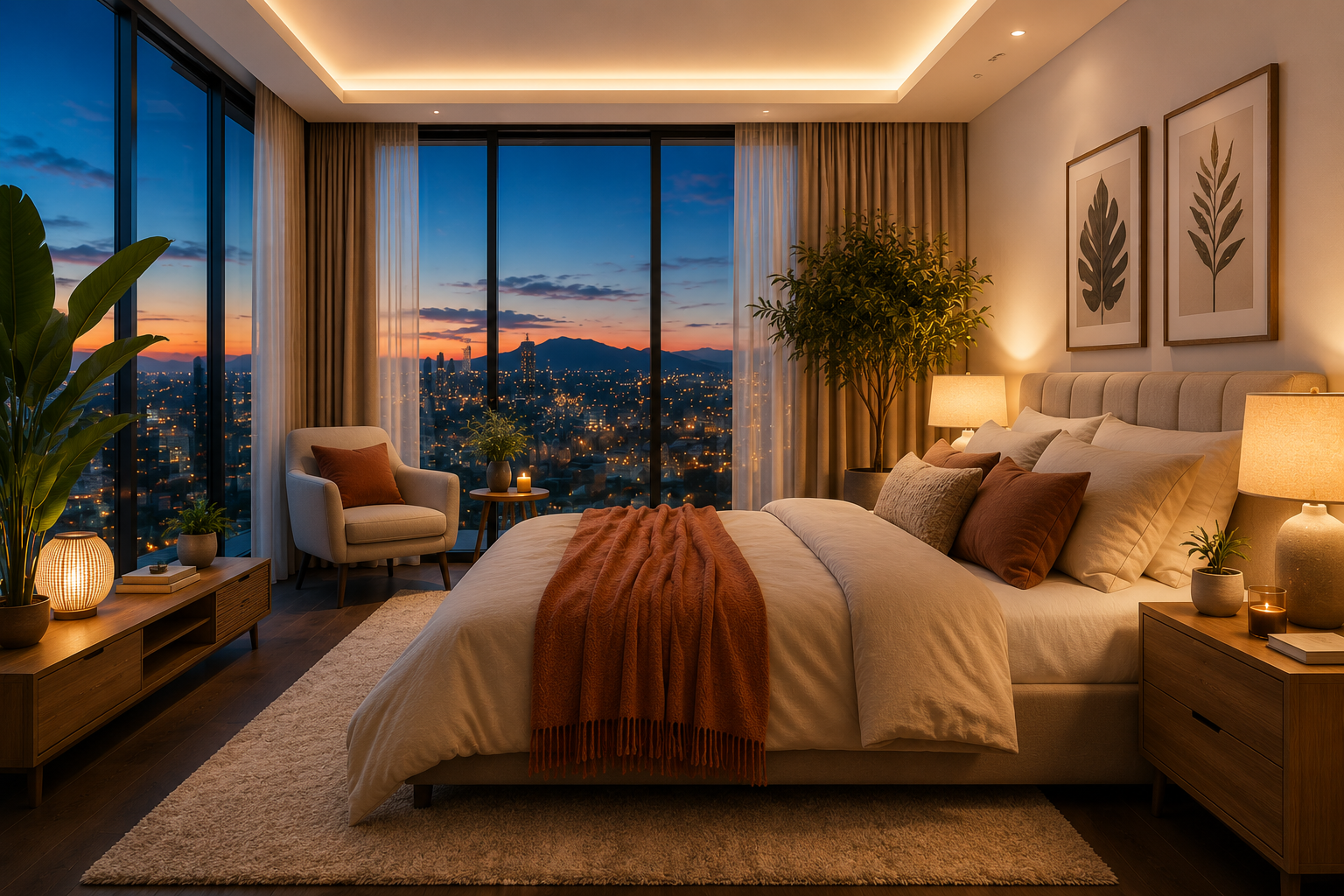
You know that feeling when you walk into a hotel room and your whole body just… exhales? The lighting is warm, the pillows are stacked in that perfect ridiculous way, and the room smells faintly of something clean and calming. For about three seconds, you think, “Why doesn’t my bedroom feel like this?”
Then you go home, look at your sad single throw pillow and the charging cable situation on your nightstand, and you sigh. Maybe you are not getting the best bedroom decor ideas from anywhere.
Here’s the thing though, you don’t need a hotel budget or an interior designer on speed dial to fix that. I’ve spent way too much time obsessing over bedroom decor ideas, testing what actually works in real-life homes versus what just looks good on Pinterest. And I’ll tell you right now: a cozy, genuinely restful bedroom in 2026 is more achievable than ever. The trends this year are leaning hard into warmth, slowness, and intention, which honestly aligns perfectly with what most of us need after the pace of the last few years.
So let’s get into it. This post covers everything from the big-picture bedroom decor shifts happening in 2026 to the small, affordable swaps that make a real difference.
Before we dive into specific ideas, it’s worth pausing on what cozy even means right now. Because cozy in 2026 isn’t the same as cozy in, say, 2018, when everything was grey and shiplap.
This year, the conversation around bedroom decor has shifted toward what designers are calling “restorative spaces”, rooms that aren’t just pretty but actively support sleep, rest, and mental decompression. According to research from the Sleep Foundation (sleepfoundation.org), your physical environment has a measurable impact on sleep quality, including factors like lighting temperature, clutter levels, and even the colors on your walls.
The trends reflect this. We’re seeing a move away from stark minimalism toward what some designers are calling “warm minimalism” or “tactile maximalism”, spaces that feel intentional but also lived-in. Think natural materials, earthy tones, layered textures, and lighting that doesn’t make you feel like you’re in a surgery room.
If there’s one bedroom decor idea that costs relatively little and changes everything, it’s layering your bedding properly. Not just a fitted sheet and a comforter — I mean actual layers.
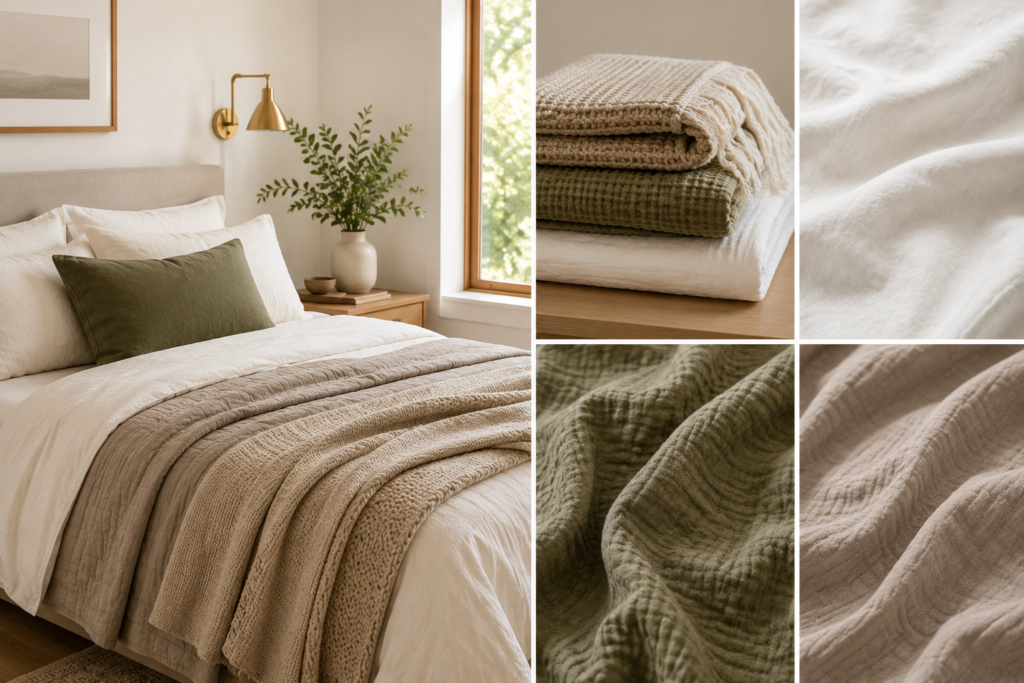
Start with a high-thread-count cotton or linen fitted sheet. Add a lightweight quilt or blanket in a contrasting texture. Then your main duvet. Then one or two throw blankets draped casually at the foot. Mix textures — something waffle-knit, something chunky, something smooth. The goal is that “tumbled-out-of-a-cozy-nest” look.
Budget picks that work well:
The Architectural Digest team noted in their 2025 bedroom trend roundup that layered bedding consistently ranks as one of the most impactful and affordable bedroom upgrades homeowners make (architecturaldigest.com).
Here’s something most people don’t realize until someone tells them: overhead lighting is quietly ruining your bedroom’s vibe. That single ceiling fixture washing everything in bright white light at 10 pm is actively working against your ability to wind down.
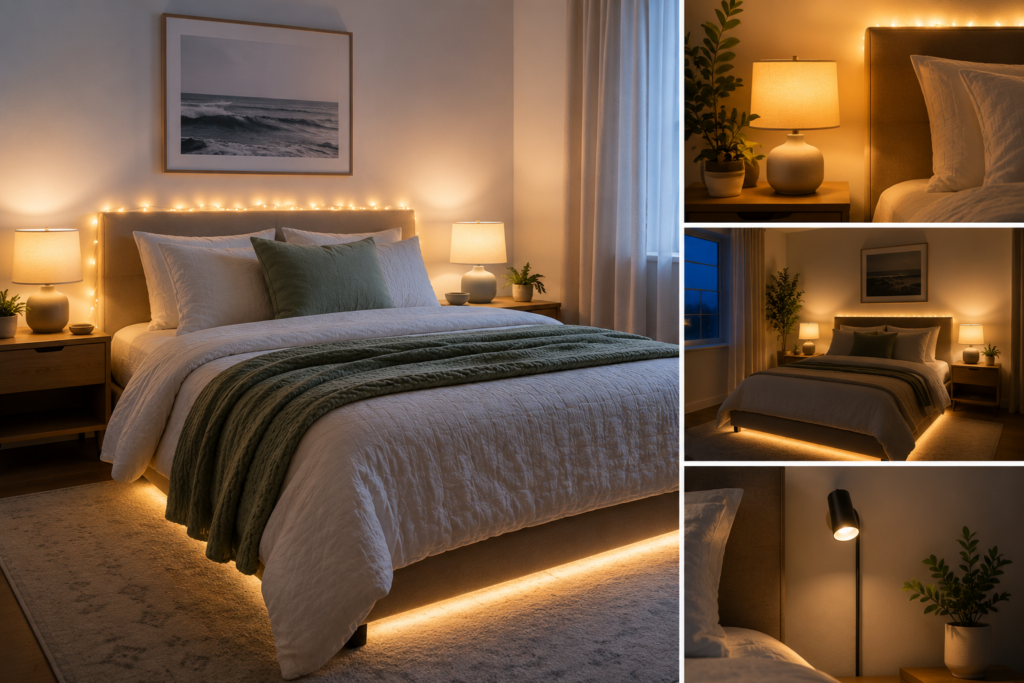
The fix is layering your light sources, the same way you layer textiles. You want:
Ambient light, a warm-toned lamp on each nightstand (aim for bulbs around 2700K color temperature) Accent light, a string of Edison-style fairy lights tucked behind a headboard, or LED strips along the bottom of the bed frame Task light, a small directional reading lamp if you read in bed
Switching to warm-toned smart bulbs (Philips Hue or the cheaper Govee alternatives) lets you dim everything down in the evening without buying all new fixtures. This is genuinely one of the best bedroom decor ideas for impact versus cost. The American Academy of Sleep Medicine has been vocal for years about how blue-light exposure in the evening disrupts melatonin production, warm lighting in your bedroom is not just aesthetic, it’s physiological (aasm.org).
A headboard does something to a bedroom that’s hard to quantify until you add one. It anchors the whole room. It makes the bed feel intentional rather than just a mattress on a frame.
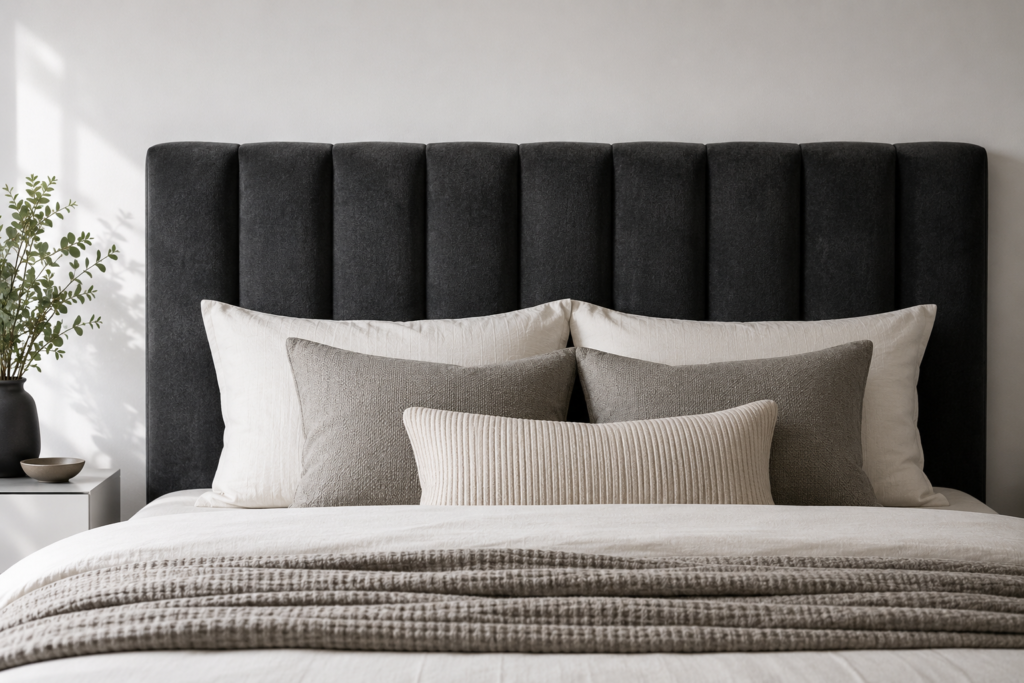
In 2026, the bedroom decor trends are leaning toward:
Upholstered headboards in boucle or velvet, warm, soft, and genuinely comfortable to lean against when you’re reading. Rattan or cane headboards: earthy, light-filtering, great for rooms that already have wood tones DIY fabric panels, literally just foam, batting, fabric, and a staple gun; dozens of tutorials on YouTube for under $80 total
If a new headboard is out of budget, a gallery wall above your bed can do similar visual work. Three to five art prints in cohesive tones, matted and framed simply, give the bed a sense of context without costing much.
I know, I know. “Add plants” feels like the most obvious advice on the internet. But hear me out, there’s a reason every beautifully decorated bedroom you’ve ever seen has at least one living thing in it.
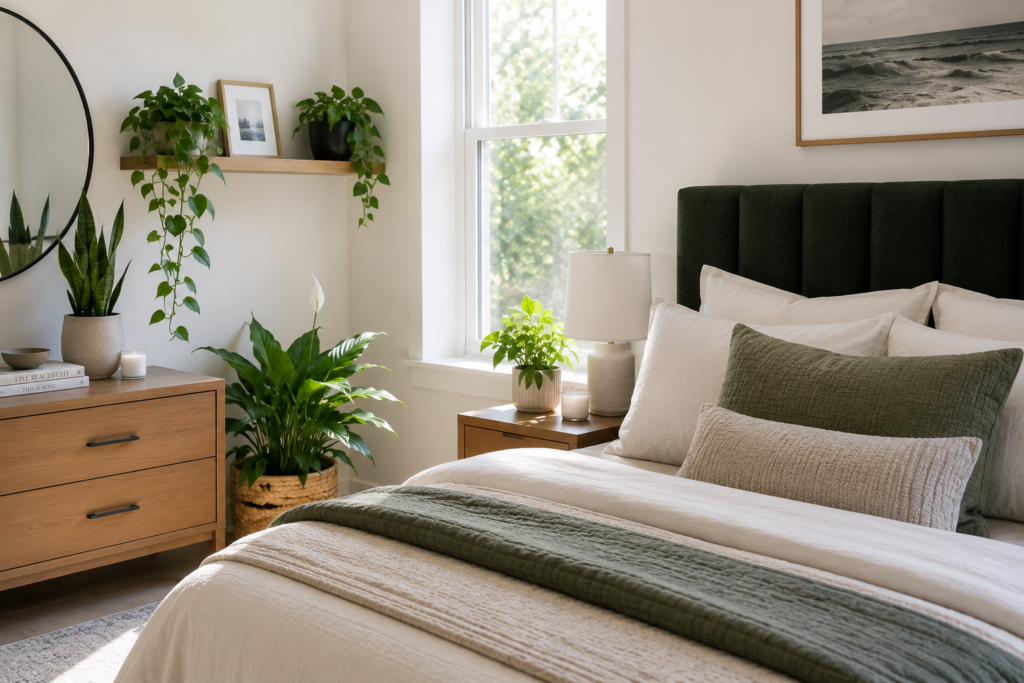
Plants do a few things in a bedroom. They add organic shape, which contrasts nicely with the straight lines of furniture. They introduce color without commitment. And psychologically, multiple studies have shown that people in rooms with plants report lower stress levels. The Journal of Physiological Anthropology published research confirming that interacting with indoor plants reduces physiological and psychological stress (ncbi.nlm.nih.gov/pmc/articles/PMC4419447/).
For bedrooms specifically, low-maintenance options that tolerate low light are your friends:
Put one on your dresser, one on a floating shelf, and a small trailing one near the window. Done.
The nightstand is the last thing you see before you sleep and the first thing you see when you wake up. And most nightstands look like a convenience store counter, phone charger, water glass, three books you’re “currently reading,” an old receipt, maybe a lip balm from 2023.
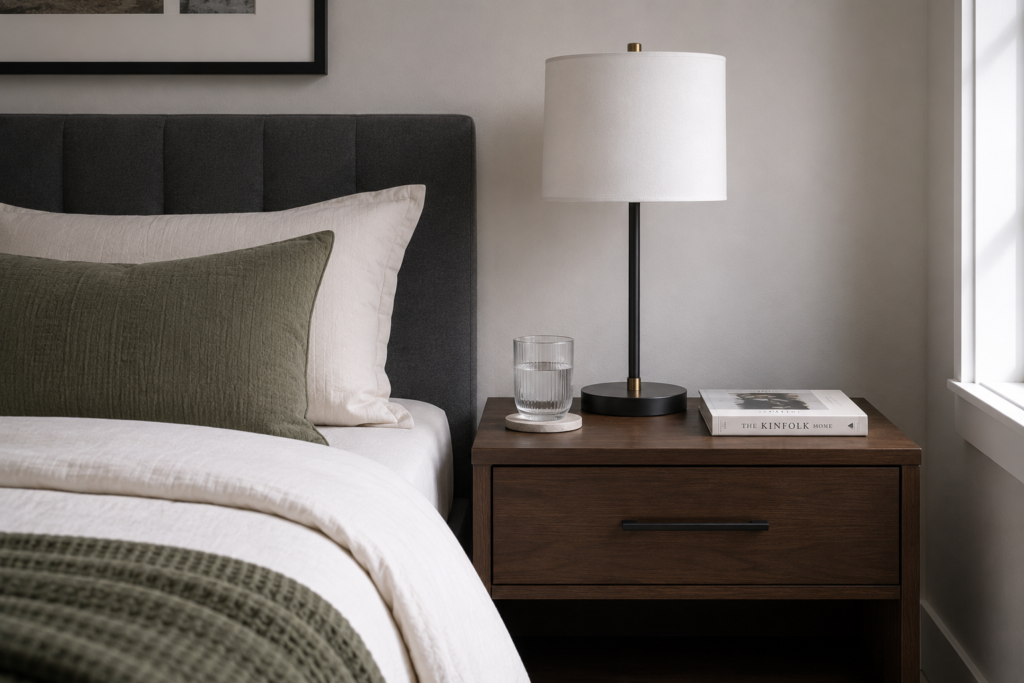
Editing this down is one of the most underrated bedroom decor ideas. Keep only what you actually use nightly: one book (just one), a lamp, maybe a small tray with your essentials. Hide the charger behind the nightstand. Get a small plant or a bud vase with a single stem for something alive and intentional.
If your nightstand is cluttered because it lacks storage, consider swapping it for one with a drawer. The IKEA HEMNES nightstand (~$100) is deep, well-built, and comes in tones that work with almost everything. Alternatively, a small wooden crate or rattan basket on the floor beside the bed can hold extras without being as visually loud as a pile on the surface.
Scent is part of your bedroom’s atmosphere. This is something boutique hotels understand and most homeowners overlook entirely.
You don’t need anything elaborate. A reed diffuser on the dresser, a soy candle burned for 30 minutes before you intend to sleep, or even a linen spray misted on your pillows does the job. Lavender is well-documented for its calming properties. Research from Johns Hopkins Medicine confirms lavender’s effectiveness in reducing anxiety and improving sleep quality (hopkinsmedicine.org).
Just be consistent. When your brain starts associating a particular scent with sleep and rest, the scent itself becomes a trigger. It’s basically a pavlovian trick that works in your favor.
If your bedroom walls are still builder-beige or cool grey from whenever you moved in, this might be the year to actually do something about it.
The bedroom decor color directions heading into 2026 are moving toward:
Warm earthy tones , terracotta, warm clay, deep sand, mushroom beige. Deep moody hues, navy, forest green, charcoal, even a deep plum done right. Soft warm whites,, not stark white but creamy, warm whites with yellow or pink undertones
You don’t have to paint all four walls. An accent wall behind the bed is a manageable project for a weekend. Or, even simpler, just change the colors of your textiles and accessories. A terracotta throw pillow, a rust-toned ceramic lamp base, a deep green plant pot. Color doesn’t only come from walls.
Benjamin Moore’s 2025 Color of the Year, Cinnamon Slate, pointed toward exactly this direction, earthy, warm, grounded (benjaminmoore.com). Expect 2026 to continue leaning into that warmth.
Even in a smaller bedroom, carving out a corner that isn’t the bed creates something valuable, a sense that the room has more than one purpose and more than one kind of rest.
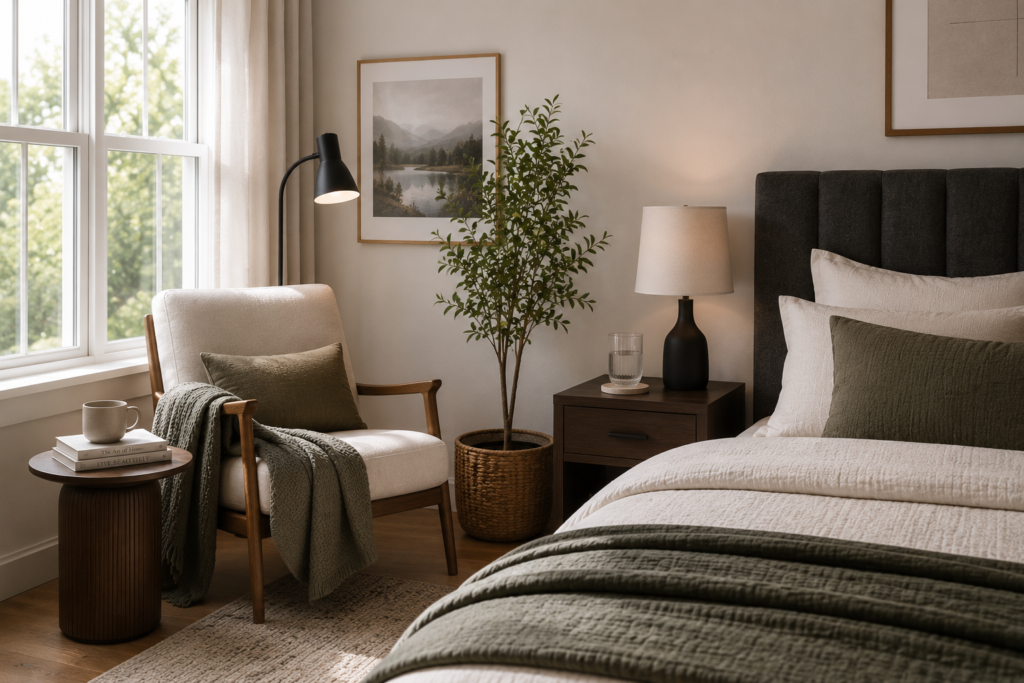
A reading nook can be genuinely simple: one comfortable chair (a secondhand armchair reupholstered in a warm fabric, or the ever-reliable IKEA POÄNG), a small side table, and a good lamp. A knit throw draped over the arm. Maybe a small stack of your actual favorite books.
This one nook signals to your brain that rest can look different things, not just sleeping, but sitting, reading, thinking quietly. That matters more than it sounds.
If you can’t do everything at once (who can?), here’s where to put your money first:
Highest impact, lowest cost: Warm-toned smart bulbs, a throw blanket in a new texture, a reed diffuser, decluttering the nightstand.
Medium investment, high payoff: Layered bedding set, a proper headboard (or DIY fabric panels), one or two plants.
Worth saving for: A quality mattress or mattress topper if yours is contributing to poor sleep. No amount of bedroom decor ideas will fix a bad mattress.
Creating a bedroom that actually feels like a retreat isn’t about spending a lot of money or following a specific aesthetic to the letter. It’s about being intentional, choosing things that serve your rest, removing things that add friction or visual noise, and building a sensory environment that signals “you can relax now” the moment you walk through the door.
The bedroom decor ideas that tend to work best in 2026 share one thing: they prioritize your actual experience of the room over how the room photographs. Warm light over bright light. Soft things to touch. A scent that calms you. A clear surface where you sleep. These are small shifts, but they compound.
Start with one corner. Change the lighting. Add one plant. See how it feels.
What’s the one thing in your bedroom right now that’s working against your ability to relax? Drop it in the comments — and if any of these bedroom decor ideas sparked something for you, share this post with someone else who’s been meaning to “do something” with their bedroom for the last two years. You know who they are.
Q1: What are the best cozy bedroom decor ideas for small bedrooms in 2026?
For smaller bedrooms, the most effective decor ideas focus on visual lightness and smart layering. Use warm-toned lighting to create depth, mount shelves vertically to draw the eye upward, and stick to a tight color palette of two or three tones. A lofted or platform bed can free up floor space, and mirrors placed opposite windows amplify natural light considerably. Keep furniture legs visible where possible — it makes the floor feel larger.
Q2: How can I make my bedroom cozier without spending a lot of money?
The highest-impact, lowest-cost bedroom decor changes are almost always lighting and textiles. Swapping cool white bulbs for warm 2700K bulbs costs under $15 and transforms the entire mood of a room. Adding one textured throw blanket, decluttering the nightstand, and introducing a single plant can all be done for under $50 total. Small, intentional changes compound quickly.
Q3: What bedroom decor colors are trending in 2026?
Warm earthy tones dominate bedroom decor in 2026 — think terracotta, warm clay, mushroom beige, and deep sand. Moody deep hues like forest green, navy, and charcoal are also strong, particularly for headboard walls. The shift is away from the cool greys that dominated the 2010s and toward colors that feel grounded and warm.
Q4: What plants are best for bedroom decor that also improve sleep?
Pothos, snake plants, peace lilies, and ZZ plants are all well-suited for bedrooms because they tolerate lower light and require minimal maintenance. Lavender, when kept on a sunny windowsill, has documented sleep-supporting properties per research from Johns Hopkins Medicine. In general, any living plant contributes to a calmer, more restorative bedroom environment.
Q5: How do I create a cozy bedroom retreat on a tight budget in Pakistan or South Asia?
Locally sourced materials work beautifully for cozy bedroom decor in South Asian homes. Look for handwoven cotton throws and khaddar fabric at local bazaars for a fraction of branded prices. Warm-toned clay lamps or earthenware vase-style lamp bases add organic warmth. Jute rugs layered under the bed add texture without the cost of imported wool. Plants from local nurseries are inexpensive and widely available. The principles are universal — warmth, texture, soft light, intentional simplicity.