Address
304 North Cardinal
St. Dorchester Center, MA 02124
Work Hours
Monday to Friday: 7AM - 7PM
Weekend: 10AM - 5PM
Address
304 North Cardinal
St. Dorchester Center, MA 02124
Work Hours
Monday to Friday: 7AM - 7PM
Weekend: 10AM - 5PM

A few years ago, I visited a friend who had just moved into a pretty ordinary apartment. Nothing fancy about the layout, nothing special about the furniture. But the moment I walked into her bedroom, something felt completely different from the rest of the place. It was calm. It felt like the room was giving you permission to breathe out.
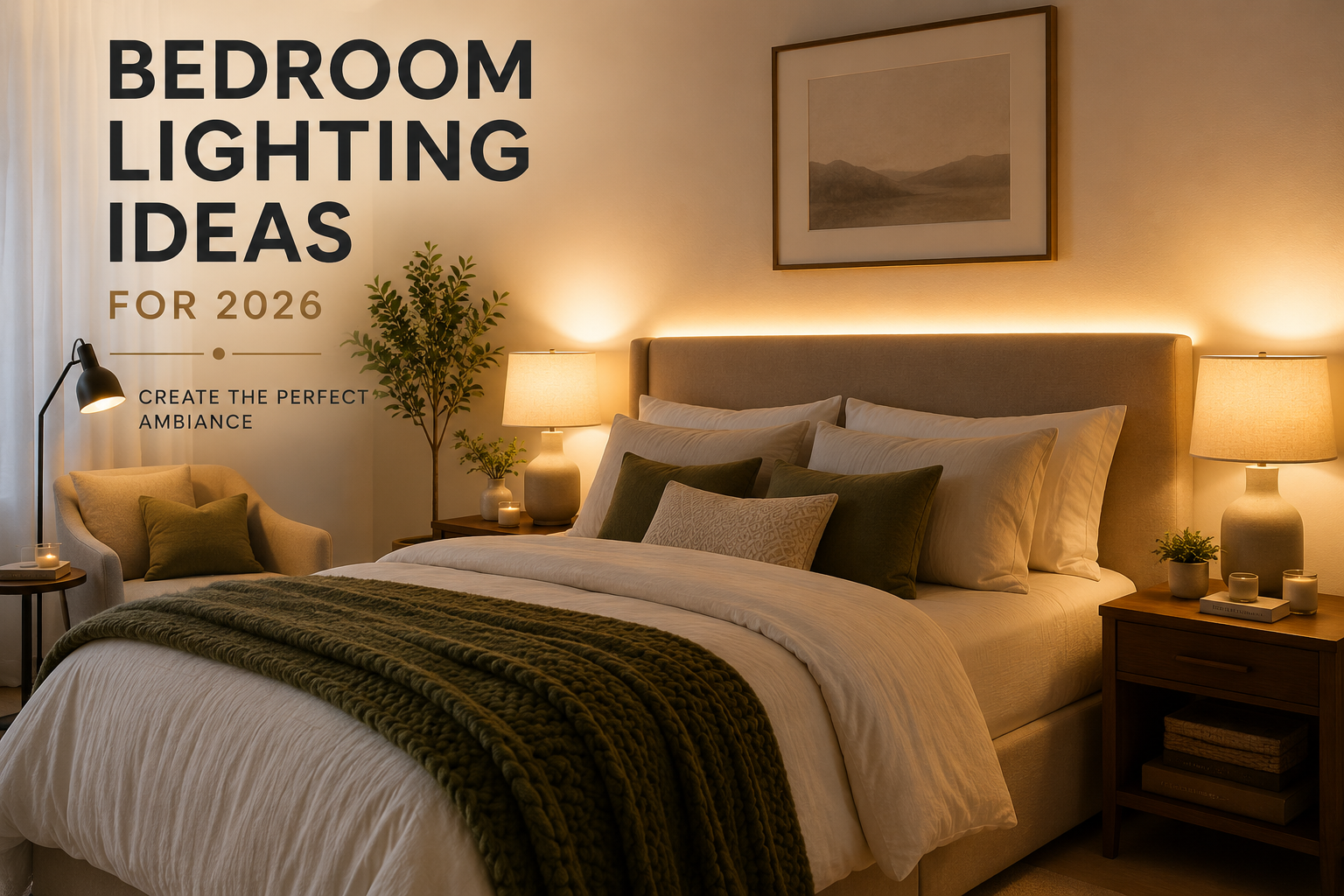
I spent a good five minutes trying to figure out what she’d done. Same walls, same bed, same curtains as my place. And then I looked up, and I noticed she hadn’t turned on the ceiling light at all. There were two warm table lamps on each nightstand, a soft LED strip tucked behind the headboard, and a small floor lamp in the corner doing very little but doing it beautifully.
That was it. Just the lighting.
It honestly changed how I think about bedroom decor. Because we pour so much energy into finding the right bedding or painting the walls a nice color, and then we flip on one big overhead bulb that washes out everything and makes the room feel like a waiting room. It doesn’t have to be this way.
This post walks you through practical bedroom lighting ideas that make a real difference, what to buy, what to swap out, and how to layer it all together without spending a fortune.
If there’s one idea in this entire post that I’d want you to take away, it’s this: stop relying on a single light source.
One overhead light does one thing. It illuminates the room evenly and flatly, which is great for offices but terrible for spaces where you want to feel relaxed. Designers have been talking about layered lighting for years, and in 2026, it’s more or less become the baseline expectation for any bedroom that feels genuinely inviting.
In practice, layering means having at least three types of light in your bedroom:

Ambient light: the general glow that fills the room (a ceiling fixture with a warm, dimmable bulb)
Task light: focused light for reading or getting ready (a bedside lamp with a directional shade, or a swing-arm wall sconce)
Accent light: decorative light that adds mood (fairy lights, LED strips behind a headboard, a small lamp on a dresser)
You don’t need all of these to be expensive. A warm-toned smart bulb in your existing ceiling fixture costs around $10-15. A simple table lamp from IKEA or Amazon can run $20-40. Small LED strip lights are often under $15 on Amazon. The layering is what matters, not the price tag.
If I had to pick just one bedroom lighting idea for someone starting from scratch, it would be this: put a lamp on each nightstand, and make sure both have warm-toned bulbs.
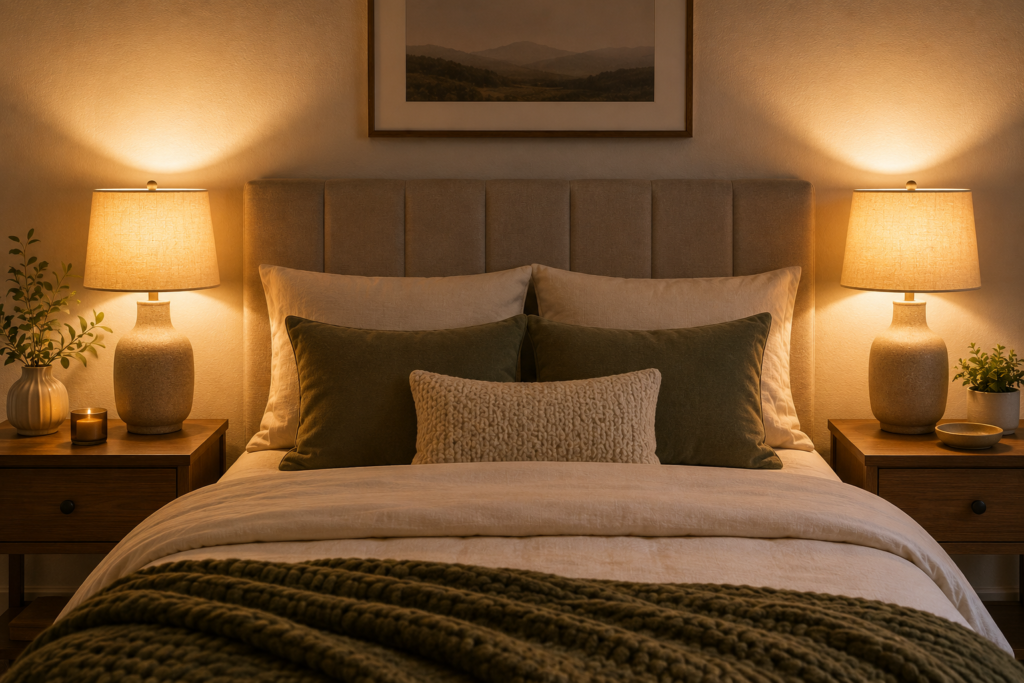
It sounds simple because it is. But the effect is significant. Two matching lamps framing the bed creates symmetry and a sense of calm. The warm glow pools on both sides of the bed and makes the whole space feel balanced and intentional. A well-placed lamp can transform even the smallest corner. Warm bulbs and textured shades create that cozy, end-of-day atmosphere that makes you actually want to be in the room.
For the lamps themselves, you don’t need to spend a lot. Some picks that hold up well and look good:
Budget options (under $40):
For the bulbs, go with 2700K soft white LEDs. Philips Hue soft white bulbs are great if you want dimming control from your phone. If you’d rather not pay the smart premium, standard GE Soft White LEDs (around $3-4 per bulb) do the same color job without the app.
Wall sconces are a bit of a secret weapon in bedroom lighting that most people overlook because they seem complicated to install. But here’s the thing, a lot of modern sconces are plug-in, meaning no electrician, no drilling into wires. You just plug them in and tuck the cord behind the nightstand or headboard.
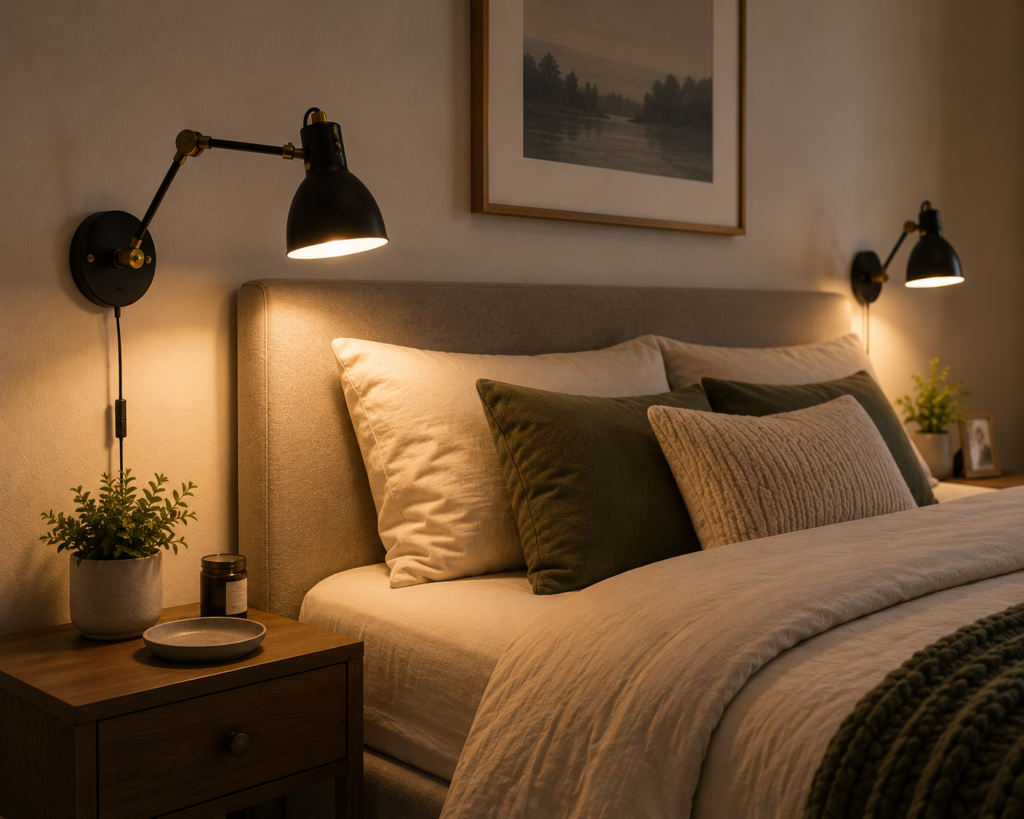
Bedrooms benefit from soft, diffused wall lights by the bed for that calm, hotel-at-home glow. Bonus points if they’re dimmable, because nobody needs full brightness at midnight.
Swing-arm sconces are particularly useful because they give you directed light for reading without requiring a lamp taking up nightstand space. If your nightstand is already crowded, mounting the light on the wall above it frees up the surface entirely.
Plug-in sconces worth looking at:
This one gets a bad reputation because of the very visible rainbow LED strips teenagers stuck under their desks a few years ago. But done right with the right color temperature and placement, LED strips behind a headboard are one of the more effective bedroom lighting ideas going.
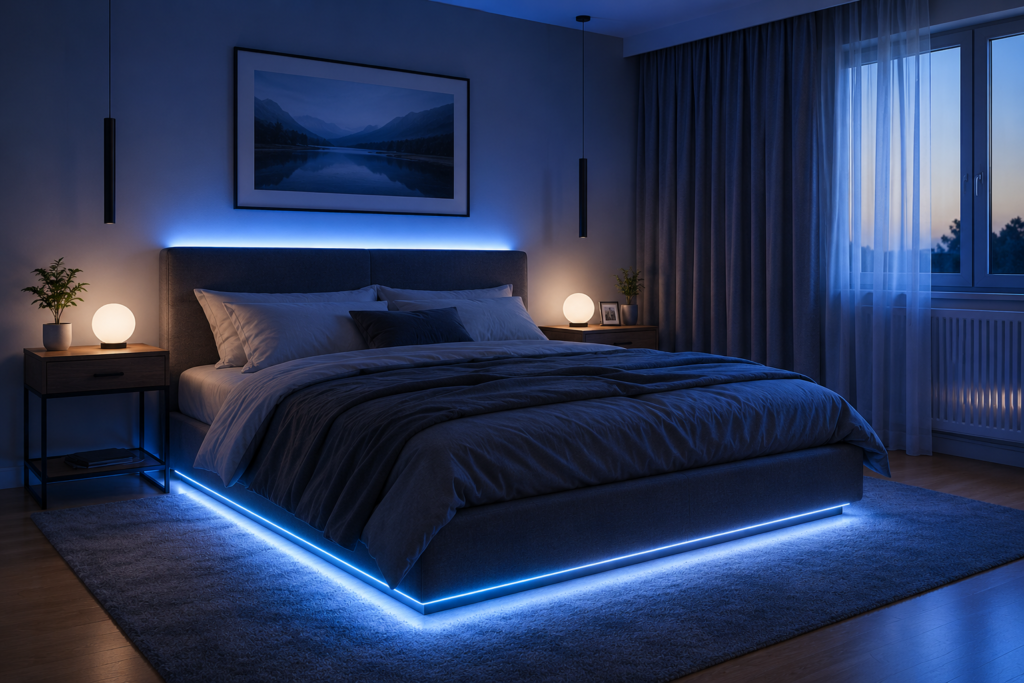
The trick is choosing a warm white strip (again, 2700K or even warmer) rather than a color-changing RGB strip. You’re not going for a gaming setup. You want a soft halo of warm light that makes the headboard look like it’s glowing from behind.
Stick the strip along the back edge of the headboard where the wall meets the frame. The light bounces off the wall behind it and creates a diffused, indirect glow. It’s subtle, atmospheric, and costs about $12-20 for a decent strip on Amazon.
Govee’s warm white strips are consistently well-reviewed and easy to work with. Just make sure to choose the non-color-changing version for a bedroom setting.
If your bedroom has a ceiling fixture and it’s wired into the wall switch, the best $15-25 you can spend on bedroom lighting is a dimmer switch. Lutron makes some of the most reliable ones, and most are straightforward to install if you’re comfortable with basic electrical work (turn off the breaker, swap the switch, done in 20 minutes).
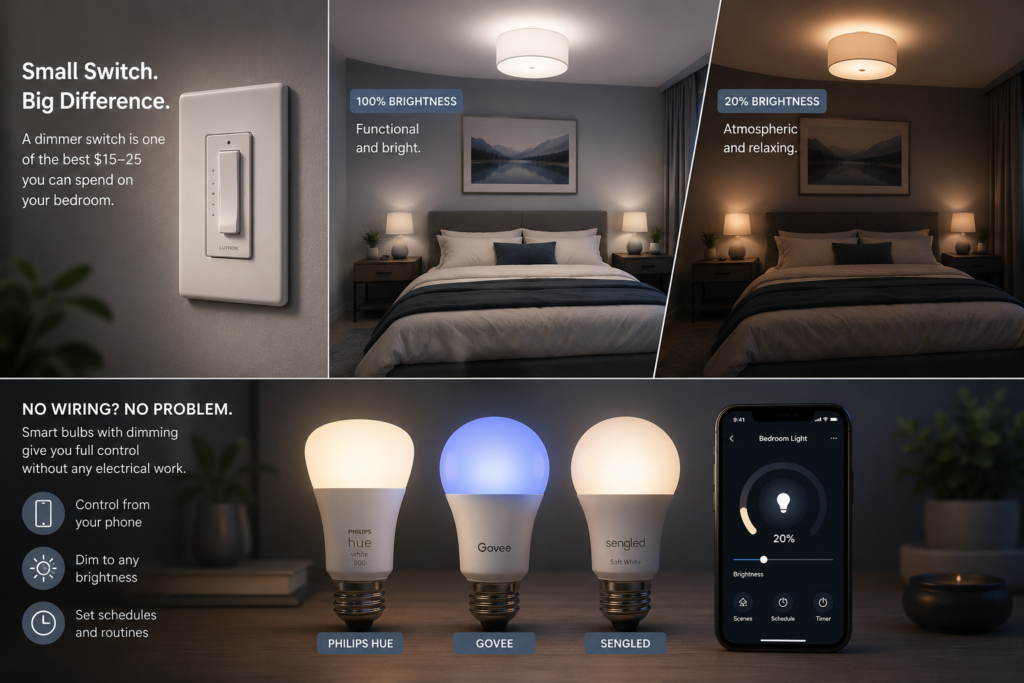
Being able to bring the overhead light down to 20% in the evening completely changes how the room feels. At full brightness it’s functional. At low brightness it becomes atmospheric. Your brain actually responds differently to the lower light level and starts winding down earlier.
If you’d rather not touch the wiring, smart bulbs with dimming capability via an app (Philips Hue, Govee, or the cheaper Sengled bulbs) give you the same control without any electrical work at all.
Okay, I know candles aren’t technically “lighting” in the functional sense. But they deserve a spot here because the effect of even one or two candles in a bedroom at night is genuinely hard to replicate with any bulb.
Candlelight flickers. It’s variable. And that slight movement of light does something to a room that static electric light can’t quite match. There’s actual research behind this, the irregular nature of candlelight is naturally relaxing to the brain in a way that consistent electric light isn’t.
If you’re worried about the fire risk (a valid concern, especially if you tend to fall asleep reading), flameless LED candles have gotten genuinely good in the last few years. The HOMEMORY Flickering Flameless Candles on Amazon are consistently recommended because the flame simulation is more convincing than most, and they’re available with a remote so you can turn them off from bed.
For real candles, soy-based ones burn cleaner and last longer than paraffin. A lavender or cedarwood scent while you’re at it doesn’t hurt either.
One bedroom lighting idea that costs almost nothing is rethinking how you handle your natural light during the day. Sheer curtains instead of blackout curtains in the morning let soft, diffused daylight into the room and genuinely make you feel better waking up. According to Sleep Foundation research (sleepfoundation.org), morning light exposure actually helps regulate your circadian rhythm, which in turn makes it easier to wind down at night.
At night, the reverse applies. If streetlights or exterior lighting is bleeding through your curtains, blackout or blackout-lined curtains make a real difference for sleep quality.
A good layered window treatment, sheer panels for daytime light diffusion plus blackout panels for nighttime, gives you control over light at every hour of the day. IKEA’s MAJGULL blackout curtains ($25-30 per pair) are a consistently reliable budget option.
Nearly every bedroom has an overhead light fixture, and nearly every overhead light fixture makes the room feel harsh if it’s the only thing on. The ceiling fan with a light kit is possibly the most common bedroom lighting villain in existence.
The fix isn’t necessarily replacing the fixture. It’s changing what it does. A few options:
Replace the bulbs with warm dimmable LEDs — if your fixture takes standard bulbs, going from a cool 4000K to a warm 2700K changes the whole feel immediately.
Add a frosted globe cover — bare bulbs or clear bulbs with visible filaments cast sharp shadows. A frosted cover diffuses the light and softens everything.
Use it less — seriously, once you have good bedside and accent lighting, the overhead light becomes something you use when you’re getting dressed in the morning and then leave off the rest of the time. That’s fine.
As designer Sonia Chauhan explains, “The goal isn’t just to brighten the room, but to shape how it feels. The right lighting can make a space instantly more relaxed, cozy, and inviting.”
That’s a good frame for all of it, honestly. You’re not trying to eliminate darkness from the room. You’re trying to shape it.
The fixture itself is part of your bedroom decor, not just the light it produces. In 2026, the trend is clearly moving toward warmer metals and more textured materials in lighting fixtures. The icy chrome era is fading. Softer, warmer finishes that feel inviting rather than clinical are taking its place, warm brass, matte black, and bronze are leading the shift.
For bedroom lighting specifically, lampshades in linen, rattan, or fabric diffuse light beautifully and add texture to the room at the same time. A bare metal lamp with a linen shade is genuinely one of the better bedroom decor investments you can make because it looks intentional and diffuses light warmly.
Rattan pendant shades in particular are worth mentioning, they’ve become popular specifically because the woven structure filters light into beautiful dappled patterns on the ceiling and walls. A simple rattan pendant over a reading chair or in a corner creates something that feels very deliberate and considered without costing a lot. You’ll find options on Amazon, H&M Home, and Urban Outfitters in the $30-60 range.
Most of us treat lighting like an afterthought. We pick a lamp because it matches the dresser, or we just use whatever fixture came with the apartment. But bedroom lighting shapes how the entire room feels, morning and night.
Here’s something that floored me when I first read it: according to research published on the NIH (National Institutes of Health) website, even dim light exposure during sleep can reduce sleep quality and affect your health over time. And separately, experts at Health Council Canada note that blue-toned light actively suppresses melatonin, the hormone that tells your brain it’s time to sleep (healthcouncilcanada.ca).
So getting your bedroom lighting right isn’t just an aesthetic thing. It’s genuinely connected to how well you sleep.
The fix is pretty simple once you understand it. Warm-toned light in the 2700K to 3000K range is what you want in a bedroom. That’s the soft, golden glow that feels like a candle or a sunset rather than a fluorescent office. According to Feit Electric’s lighting guide (feit.com), 2700K is the gold standard color temperature for bedrooms because it promotes relaxation and doesn’t fight against your body’s natural wind-down process.
If you’re starting from scratch or doing a refresh, here’s a simple sequence to follow:
First, swap every bulb in your bedroom to a 2700K warm white LED. This alone changes more than you’d expect.
Second, add a lamp on each nightstand if you don’t already have them. Warm bulb, simple shade.
Third, add one accent element — LED strip behind the headboard, a string of Edison bulbs along a shelf, or a small lamp on a dresser or windowsill.
Fourth, if your bedroom has a ceiling fixture on a wall switch, add a dimmer. If you can’t or don’t want to, get smart bulbs you can dim from your phone.
Fifth, consider one candle or flameless candle for the evenings when you want the room to feel especially quiet.
That’s genuinely all of it. You don’t need a designer. You don’t need to gut the room. Most of this can be done for under $100 total.
The right bedroom lighting is one of those things that sounds minor until you experience the difference. It’s not about making the room look good in photos. It’s about how the room feels when you walk into it at the end of a long day and want the rest of the world to quiet down for a while.
Warm light, layered across a few sources, does something that no amount of throw pillows or wall art can fully replicate on its own. It tells your brain the day is over. It makes a regular room feel like a retreat. And honestly, in a year where everyone is looking for a little more calm at home, that matters.
Start with the bulbs. Add a lamp. See how it feels. My guess is you’ll wonder why you didn’t do it two years ago.
What does your bedroom lighting look like right now? Is it still running on that one sad ceiling fixture?
Q1: What is the best bedroom lighting for a warm and cozy feel?
The best bedroom lighting for warmth combines multiple light sources rather than relying on one overhead fixture. Use bedside table lamps with 2700K warm white bulbs for ambient glow, add a plug-in wall sconce for reading light, and include a soft accent like LED strips behind the headboard. This layered approach creates depth and warmth that a single ceiling light simply cannot achieve on its own.
Q2: What color temperature bulb is best for bedroom lighting?
For bedroom lighting, choose bulbs in the 2700K to 3000K range. This warm white color temperature produces a soft, golden glow similar to candlelight and has been shown to support melatonin production, which helps your body wind down before sleep. Avoid bulbs above 4000K in the bedroom as they emit blue-toned light that can disrupt your natural sleep cycle.
Q3: How can I make my bedroom lighting feel more like a hotel room?
The hotel bedroom look comes from layered lighting and warm tones. Hotels use bedside lamps on both sides of the bed (never just one), dimmable overhead lighting set low in the evening, and often a subtle accent light behind the headboard or in a corner. Matching lampshades and warm bulbs in the 2700K range complete the effect. Plug-in wall sconces are an easy way to get that hotel-style mounted light without any electrical work.
Q4: What are the best budget bedroom lighting ideas in Pakistan or South Asia?
In Pakistan and across South Asia, warm atmospheric bedroom lighting is very achievable on a small budget. Local bazaars in cities like Lahore, Karachi, and Islamabad carry affordable table lamps, fabric shades, and Edison-style bulbs. LED strips for behind headboards are widely available online through Daraz and similar platforms for under PKR 1,000-1,500. Earthenware lamp bases and handwoven fabric shades sourced locally also add warm texture at a fraction of imported prices.
Q5: Should bedroom lights be bright or dim at night?
Bedroom lights should be dimmed significantly in the evening, ideally below 200 lux as bedtime approaches. Bright overhead lighting in the hour before sleep has been shown to suppress melatonin production and make it harder to fall asleep. Use bedside lamps or accent lighting only after dinner, and if your ceiling fixture is on a dimmer, bring it down to the lowest comfortable setting. The goal is to gradually reduce light exposure in the bedroom as bedtime gets closer, which signals to your body that it’s time to rest.