Address
304 North Cardinal
St. Dorchester Center, MA 02124
Work Hours
Monday to Friday: 7AM - 7PM
Weekend: 10AM - 5PM
Address
304 North Cardinal
St. Dorchester Center, MA 02124
Work Hours
Monday to Friday: 7AM - 7PM
Weekend: 10AM - 5PM

Whether you have a small apartment living room or a large open-plan space, the right lighting changes everything. This guide covers 25 living room lighting ideas including ceiling lights, floor lights, wall lights, hanging lights, and smart lighting tips for every home in 2026.
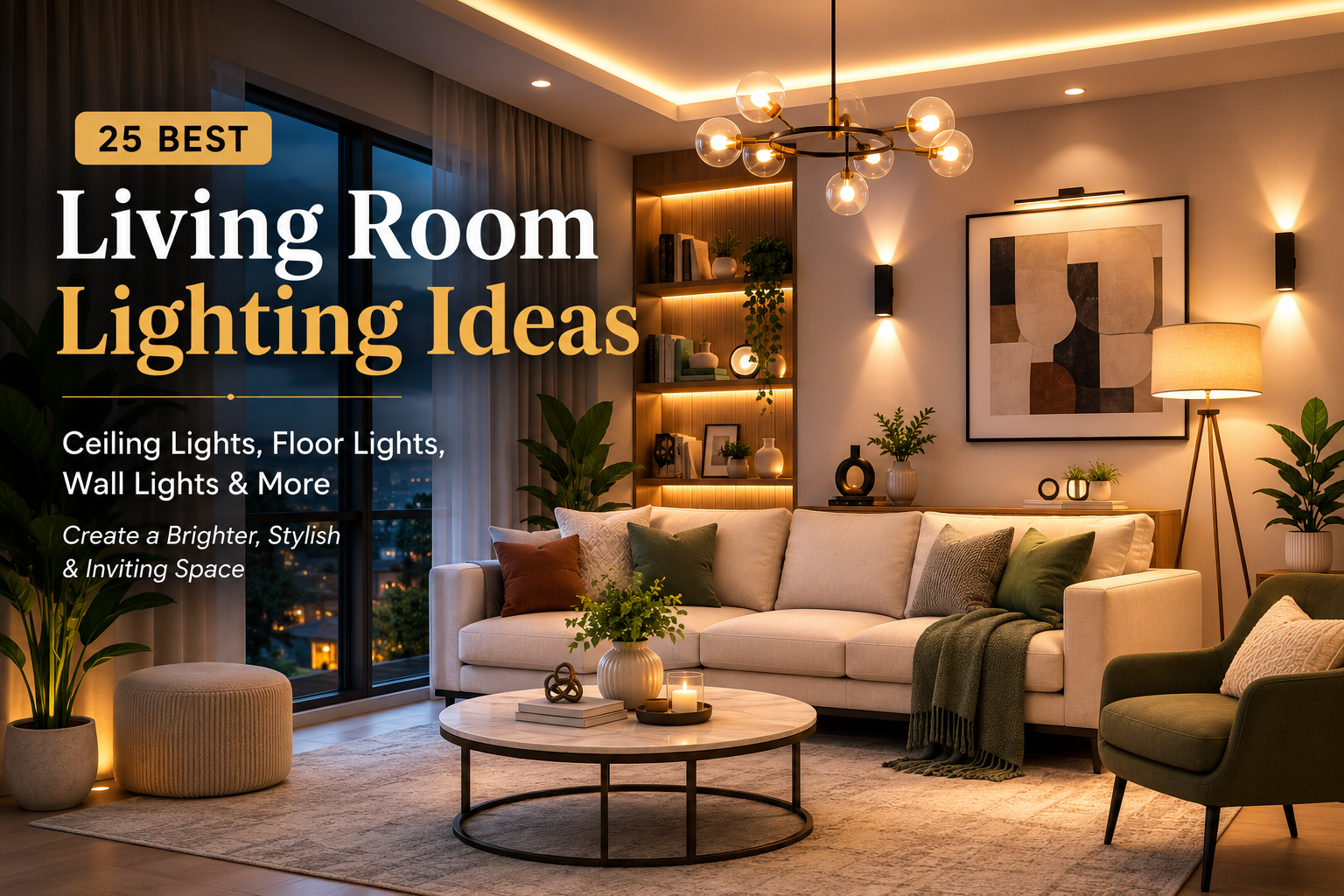
Choosing the right living room lighting can completely change how your home looks and feels. Whether you are planning a fresh update or just want to upgrade your living room lights, knowing your options makes the whole process much easier. Good living room lighting ideas go beyond one bulb in the ceiling, they combine ceiling lights for living room spaces, floor lights for living room corners, and wall lights for living room walls to create something that feels warm, layered, and intentional. This guide walks you through every type of light, where it works best, what to avoid, and how to put it all together—no design degree needed.
Before jumping into specific fixtures, it helps to understand the four main categories of living room light. Every good lighting plan uses a mix of these
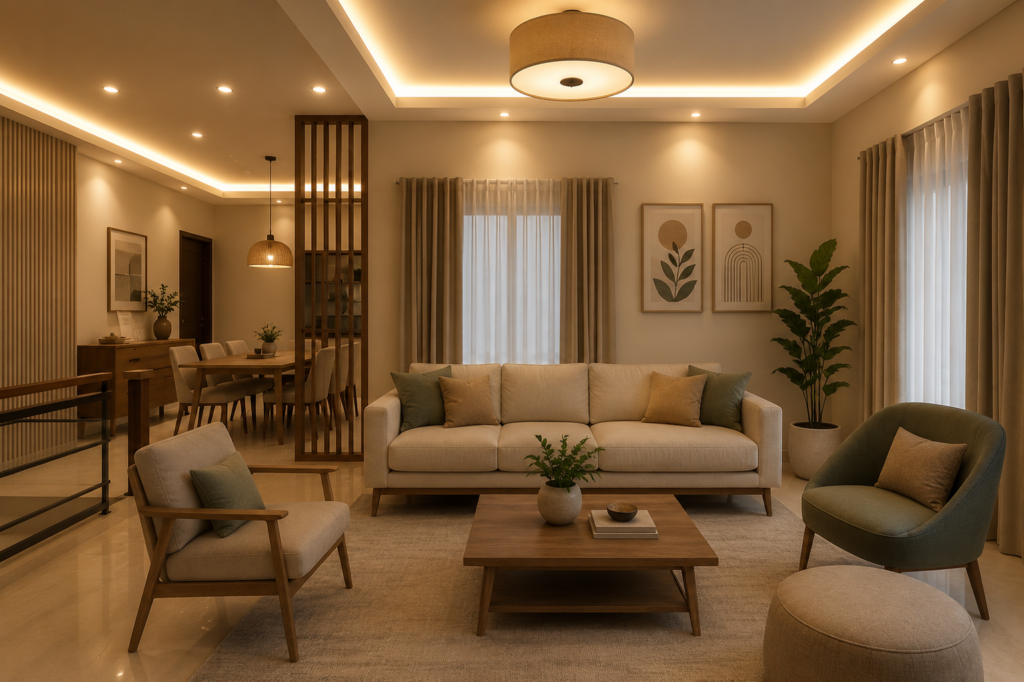
Ambient lighting is your base layer. It lights up the whole room and is usually what people think of first — the main ceiling light or a chandelier. Without ambient light, the room is just dark.
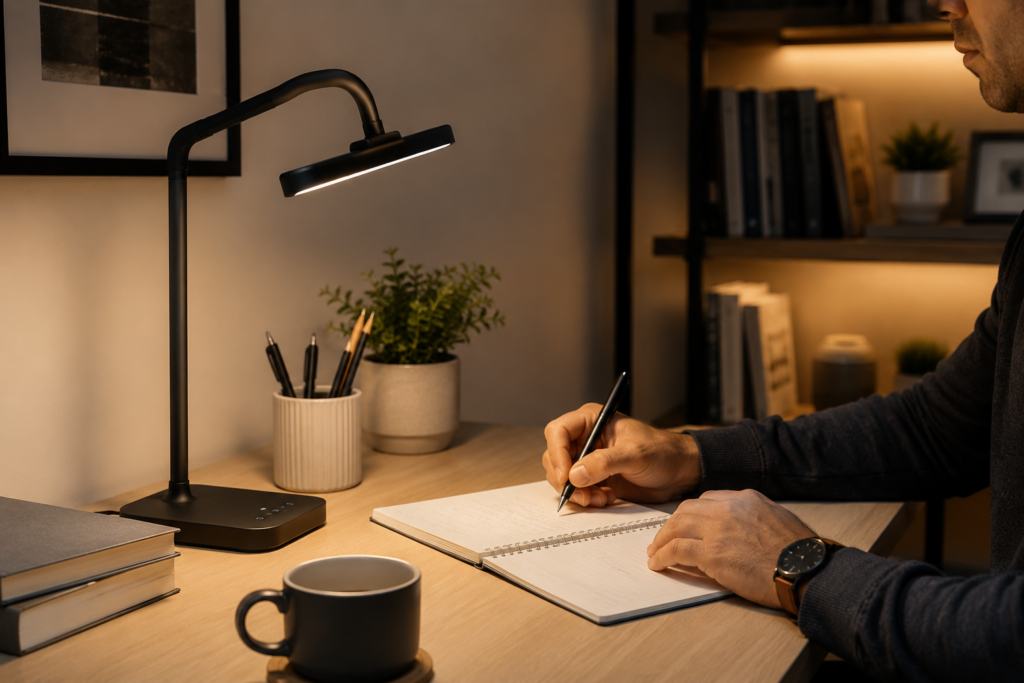
Task lighting is focused and practical. It is the lamp next to the sofa where you read, or the light above a desk in the corner. It is bright and directed at a specific purpose.
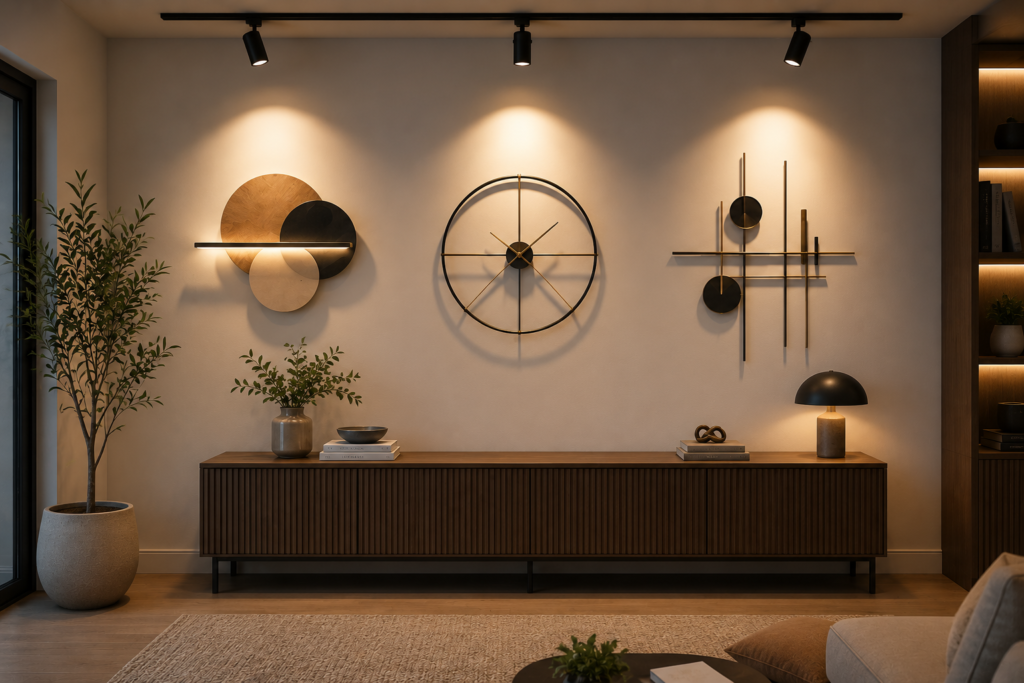
Accent lighting is used to highlight things. A picture light above a painting, a small spotlight aimed at a plant, or LED strips behind a TV unit — these draw the eye and add dimension to a room.
Decorative lighting is all about style. A sculptural floor lamp or a colourful pendant might not even produce much light, but it looks great and adds personality to the space.
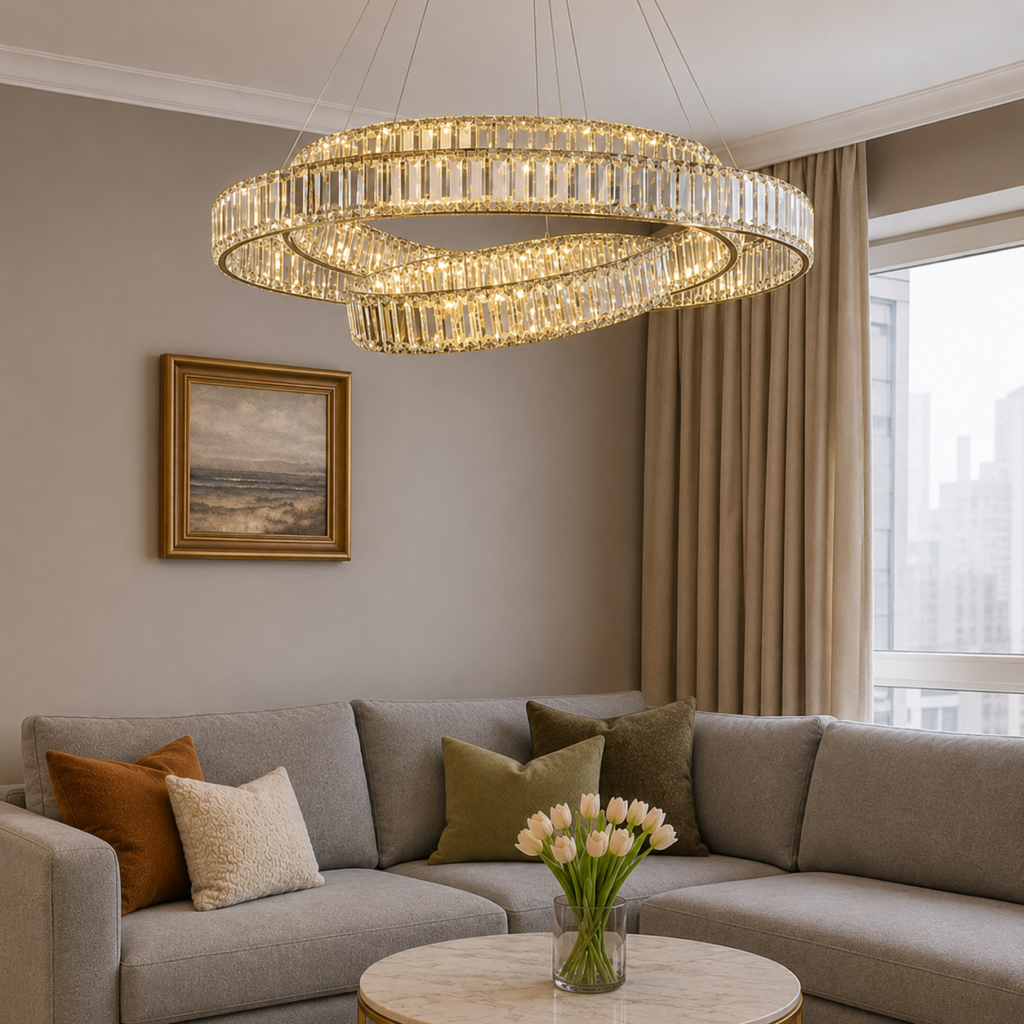
The best living room lighting ideas use all four of these together. That is what designers call layered lighting, and we will come back to it later.
Ceiling lights for living room spaces do the heavy lifting. They are usually the first thing people install and the last thing they think about improving. Here is a breakdown of the main types.
These sit flat against the ceiling with no gap. They work well in rooms with low ceilings where a hanging fixture would feel too close to your head. They are clean and simple and come in a huge range of styles.
These hang slightly below the ceiling — usually by just a few inches. They give a little more visual interest than a flush mount while still working in rooms that are not very tall.
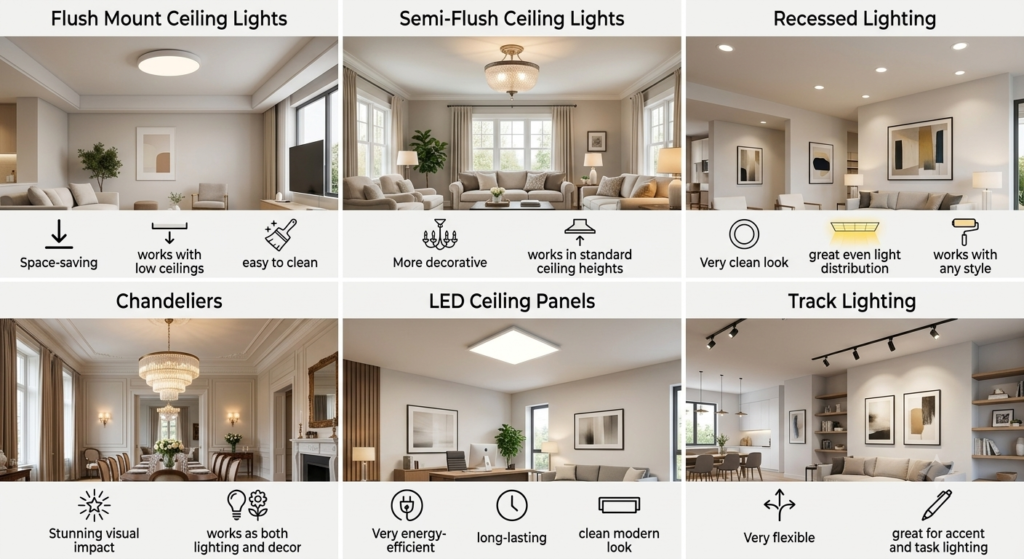
Also called downlights or can lights. These are built into the ceiling so you only see a small trim ring. They give a very clean, modern look and are great for ambient lighting across a wide space.
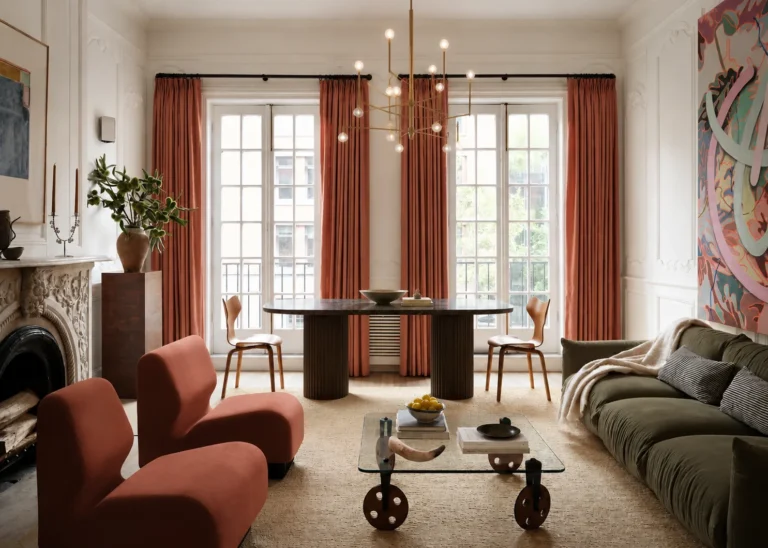
A chandelier is a statement. It hangs from the ceiling and usually has multiple lights. It adds drama, elegance, and a real focal point to the room.
Flat LED panels replace a standard ceiling fixture and provide very even, bright light. They are energy-efficient and have a long lifespan.
A track system lets you point multiple lights in different directions from a single ceiling mount. Great for highlighting art or specific areas of the room.
Hanging living room lights add height, drama, and personality to a space. They work differently to flush ceiling lights because they drop down into the room and become part of the visual experience.
Pendant lights are single hanging lights, usually over a coffee table, reading nook, or a specific area. They come in every style imaginable, glass, metal, rattan, concrete, fabric.
Cluster pendants group several hanging lights together at different heights. They look stunning in rooms with high ceilings and create a real focal point.
Modern hanging lights with geometric shapes or metallic finishes suit contemporary living rooms. Matte black and brushed brass are two finishes that are very popular right now.
Farmhouse hanging lights use warmer materials like wood, aged metal, or Edison-style bulbs to give a cozy, lived-in feel.
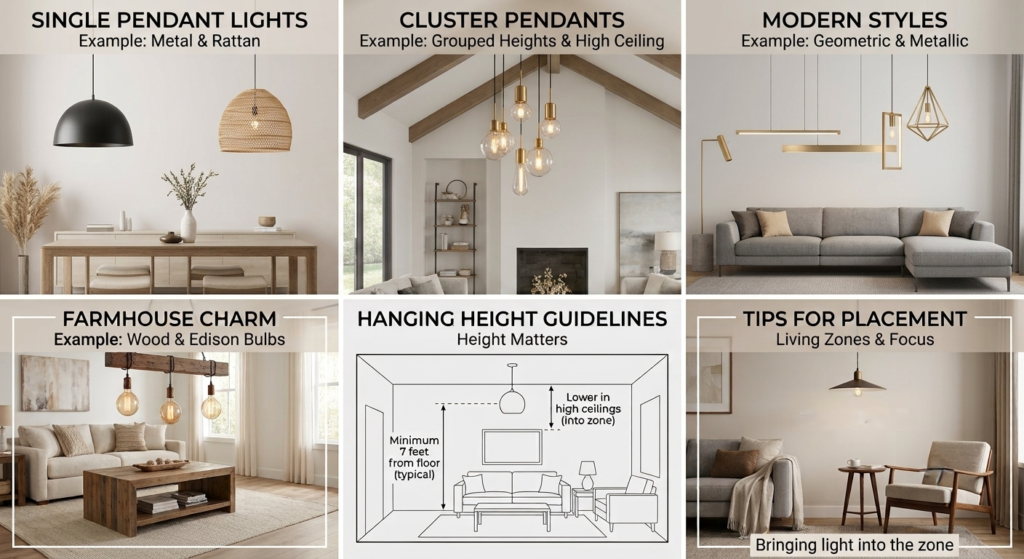
One thing to keep in mind with hanging lights and height matter. The bottom of a pendant should generally sit at least 7 feet from the floor. In a room with very high ceilings, you can go lower to bring the light into the living zone.
Floor lights for living room spaces are one of the most underrated tools in home lighting. They are easy to move, require no installation, and instantly make a room feel warmer and more complete.
Arc lamps have a long curved arm that reaches out over a sofa or chair. They are perfect for reading and also look very sleek in modern rooms.
Tripod lamps stand on three legs and have a more sculptural quality. They work well as a decorative element even when they are switched off.
Reading lamps are simple and focused. They direct light exactly where you need it, usually over a chair or the end of a sofa.
LED floor lamps are energy-efficient and often dimmable. Some also have colour temperature settings so you can switch between warm and cool light depending on the time of day.
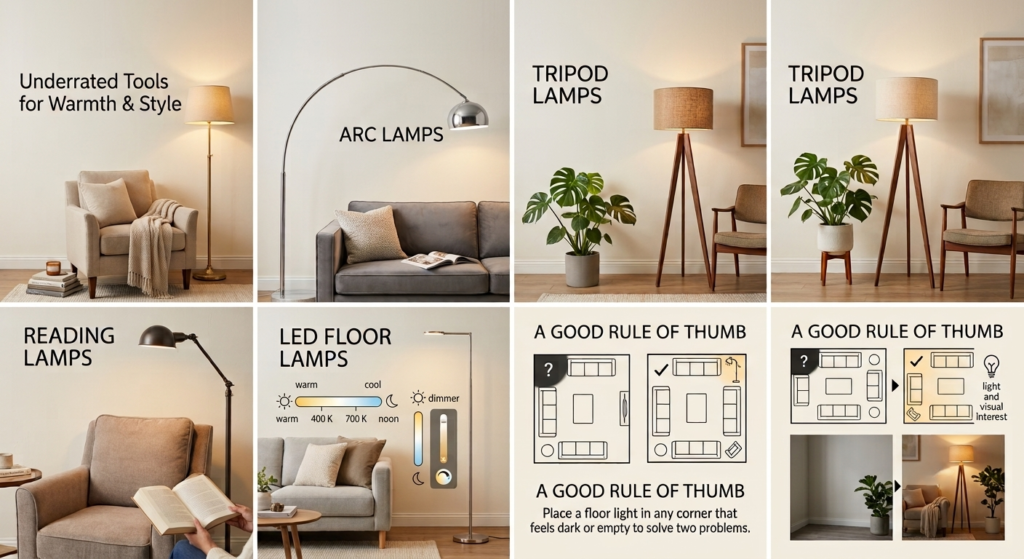
A good rule of thumb: place a floor light in any corner of the living room that feels dark or empty. It solves two problems at once, the dark corner and the lack of visual interest.
Wall lights for living room spaces do something that ceiling and floor lights cannot, they add light at eye level. This makes the room feel more balanced and human-scaled.
Wall sconces are the classic option. They mount directly to the wall and come in styles ranging from traditional candle-style sconces to very minimal modern designs.
Swing arm lights are wall-mounted but have a flexible arm that can be adjusted. Great next to a sofa or reading chair where you want to direct the light but do not have room for a floor lamp.
Picture lights are small, focused wall lights designed to illuminate artwork or a mirror. They add a gallery-like quality to a living room wall.
LED wall lighting includes strip lights and panel lights that mount flat to the wall. Behind a TV unit is a very popular placement — it reduces eye strain and adds a modern glow to the room.
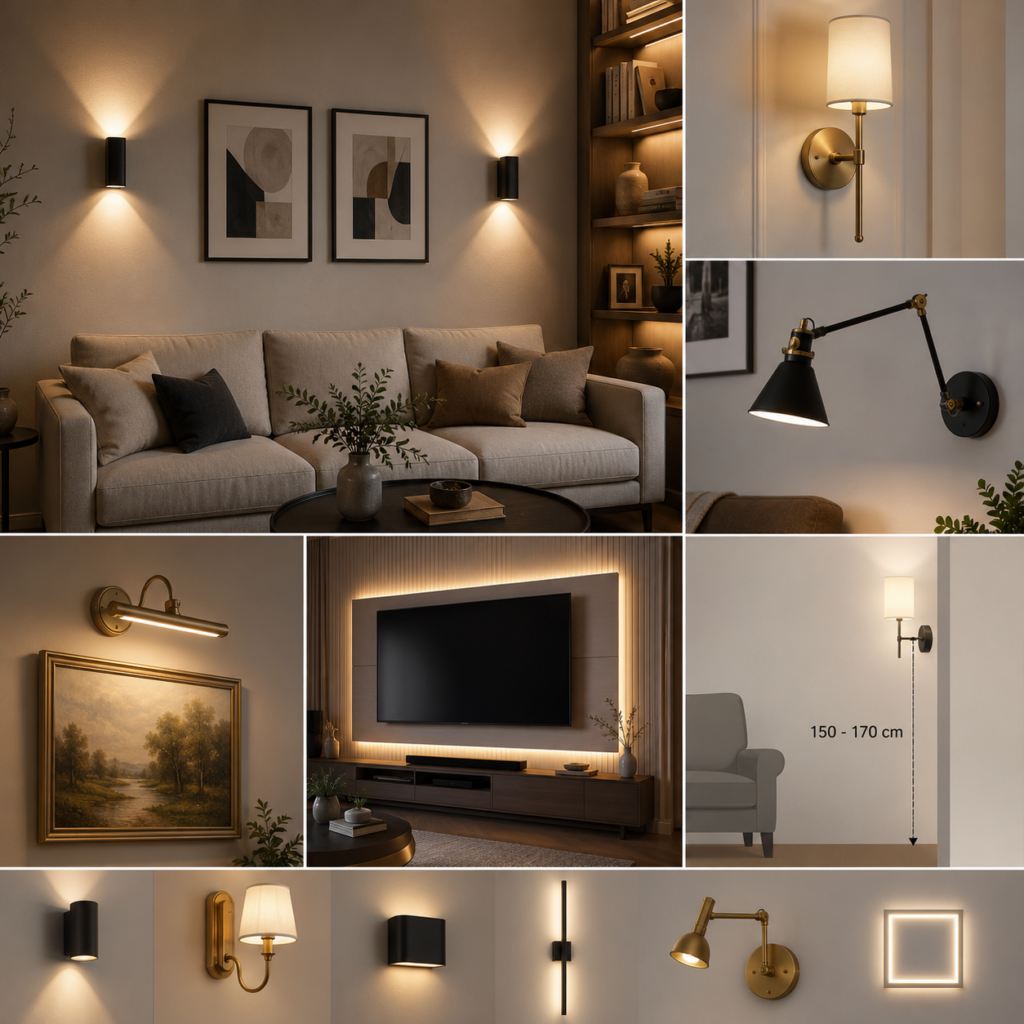
Wall lights for living room placement: aim for a height of around 150 to 170 centimetres from the floor to the centre of the fitting. This puts the light at roughly eye level when seated.
Table lamps are the most flexible lights in any room. You can move them, swap out their shades, and use them to bring warmth to any surface, a side table, a console, a bookshelf.
They also work as decorative objects. A lamp with a bold base or an interesting shade adds character to a room even in the daytime. Choose a shade that diffuses light softly rather than letting it shine harshly downward.
Decorative living room lights like LED strips inside shelving, backlit mirrors, or small accent lights near plants are the finishing touches that make a room look professionally styled. They are usually inexpensive and easy to add without any electrical work.
Smart lighting has become much more affordable and accessible. It is worth knowing about even if you are not a tech person.
Smart bulbs replace your regular bulbs and connect to your phone or a voice assistant. You can dim them, change their colour temperature, or set schedules, all without touching a switch.
Voice assistants like those built into smart speakers can control your lights by voice. Say the word and the lights adjust. Great for when your hands are full or you are settled on the sofa.
Motion sensors can turn lights on automatically when you enter the room and off when you leave. Useful for saving energy and for convenience.
Colour-changing LEDs let you shift the mood of the room completely. Warm white for evenings, cool white for working, or even colours for special occasions or movie nights.
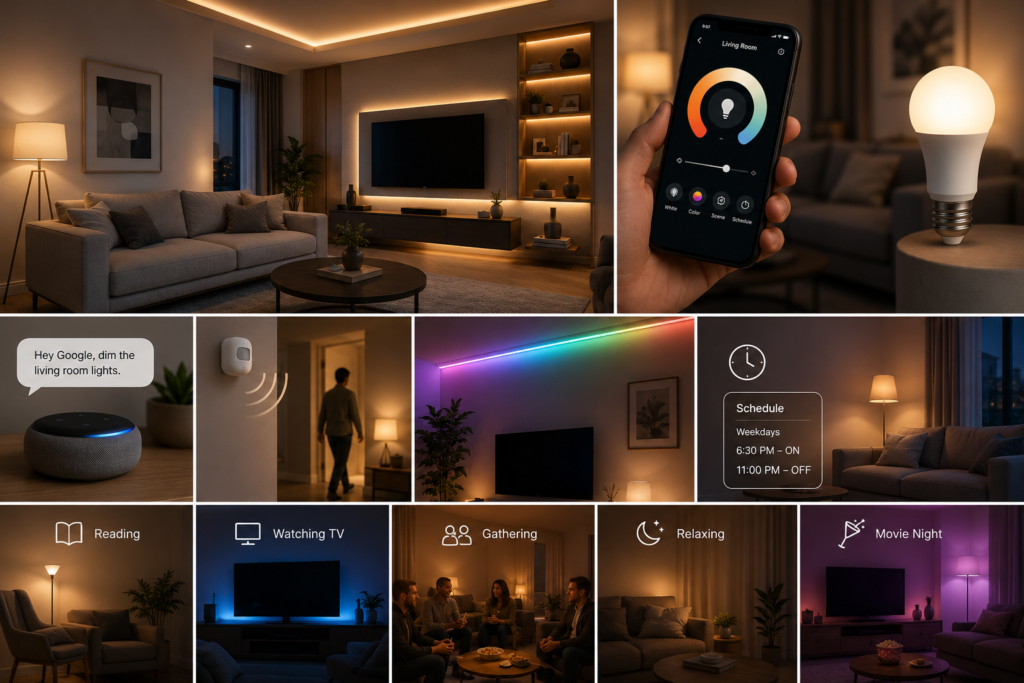
Smart lighting is especially well-suited for living rooms because the space’s mood changes so much throughout the day. Being able to adjust the light to match what you are doing, reading, watching TV, or having people over, without getting up is genuinely useful.
A small living room needs to feel as open and bright as possible. These living room lighting ideas help with exactly that.
Brighten dark corners with floor lamps or small table lamps. Dark corners make a room feel smaller. Fill them with light and the whole space opens up.
Use mirrors near light sources. A mirror opposite a window bounces natural light around the room. A mirror near a lamp doubles its effect.
Multi-purpose lights save space. A floor lamp with a built-in side table, or a wall sconce instead of a bedside table lamp, combines functions, meaning fewer items on the floor.
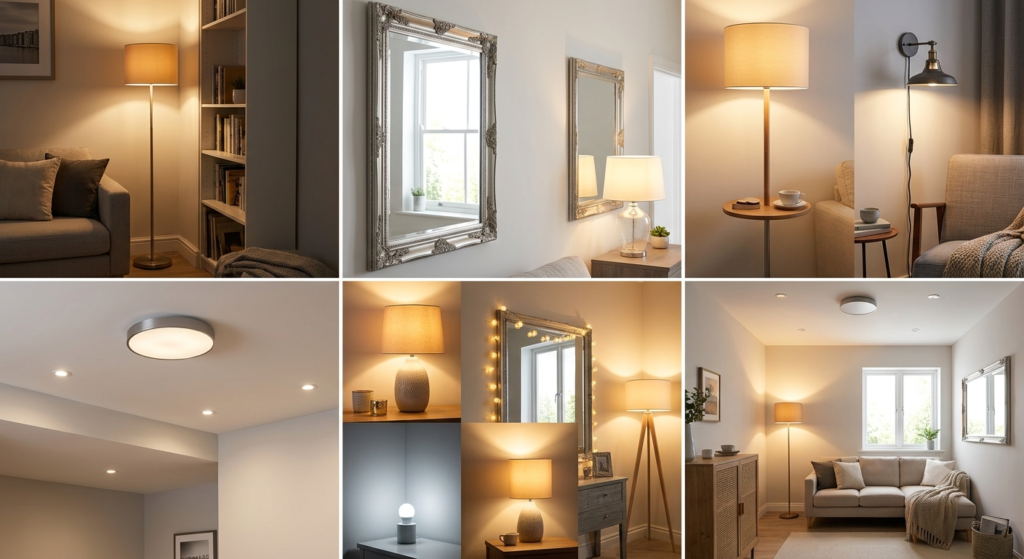
Choose flush-mount or recessed ceiling lights rather than pendants or chandeliers. Hanging lights drop into the room and can make low ceilings feel even lower.
Stick to warm white light in a small space. It feels cozy rather than exposing, and avoids that harsh, clinical feel that bright white light can give a compact room.
A large living room has the opposite problem, it can feel cold, cavernous, or poorly lit with just one or two light sources. Here is how to handle it.
Use layered lighting across the whole space. No single light source can cover a large room evenly. You need ceiling lights, floor lights, and table lamps working together.
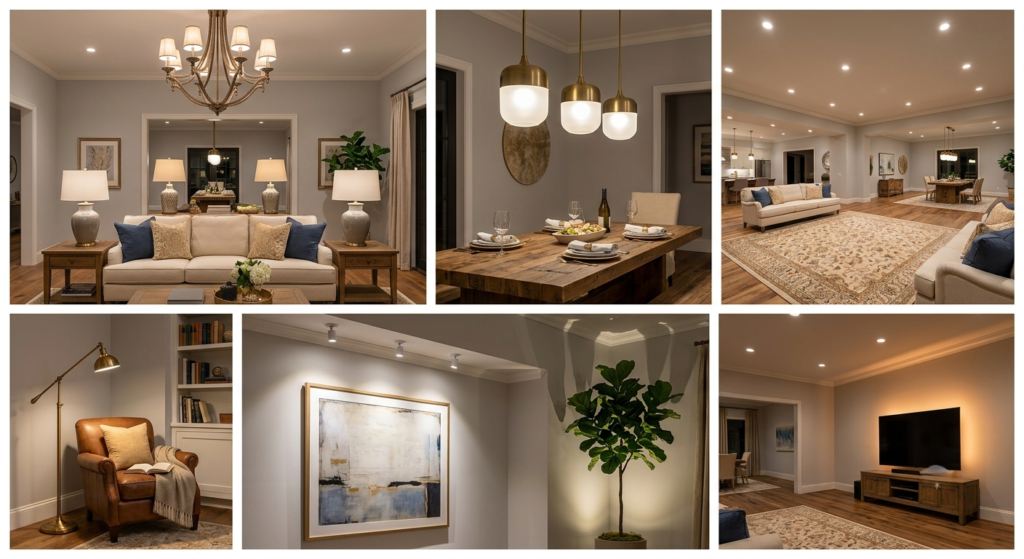
Consider multiple ceiling fixtures rather than one big one. Two or three recessed light clusters or a combination of a chandelier and recessed lights works much better than one large central fitting.
Create zones with lighting. A reading area gets a floor lamp. The TV area gets dimmable recessed lights and LED strips. A conversation area gets a pendant or table lamps. Different zones, different lights.
Use accent lighting to make the space feel considered. Highlight artwork, plants, or architectural features. This stops a large room from feeling empty.
The colour of your light is measured in Kelvin (K). The lower the number, the warmer and more yellow the light. The higher the number, the cooler and bluer it gets.
For most living rooms, 3000K is the sweet spot. It is warm enough to feel comfortable in the evening but bright enough to read and function during the day.
Every interior designer works with layers of light. It sounds complicated but it is actually simple once you understand the three levels.
Layer one: Ambient lighting. This is your main overhead light. It fills the room and is your starting point. A ceiling fixture, chandelier, or recessed lighting handles this.
Layer two: Task lighting. This is the light you use for specific activities, reading, working, and cooking. Floor lamps, table lamps, and swing-arm wall lights handle this.
Layer three: Accent lighting. This is decorative and directional. Picture lights, LED strips, small spotlights. It adds depth and draws attention to things you want to highlight.
A room with all three layers always looks better than a room with just one. Start with ambient, add task lights where you need them, then add accent lighting for personality.
Even with good intentions, these mistakes are very easy to make.
Using only one ceiling light. This creates a flat, shadowless light that makes the room feel like a waiting room. Always layer at least two or three different light sources.
Wrong bulb colour temperature. Cool white bulbs (4000K and above) in a cozy living room will always feel off. Match your bulb colour to the mood you want.
Too many bright LEDs with no dimmers. Bright light has its place but you need to be able to turn it down. Install dimmers wherever you can.
No dimmers at all. This is one of the biggest missed opportunities in home lighting. Dimmers cost very little and change the feel of a room completely.
Incorrect lamp height. A floor lamp that is too short or a pendant that hangs too low throws everything off. Floor lamp shades should sit roughly at shoulder height when you are seated.
Ignoring natural light. Always consider how much daylight your room gets before choosing your artificial lighting. A very bright, south-facing room needs different lighting than a darker north-facing one.
Here is a simple checklist to help you decide.
Think about the last time you walked into a room and it just felt right. Chances are, the lighting had a lot to do with it. Lighting for living room spaces is one of those things that people do not always notice when it is done well, but they absolutely feel it.
A living room with light in all the right places feels bigger, warmer, and more welcoming. A room with just one harsh overhead light feels flat and a little cold, no matter how nice the furniture is. The difference is not always about spending more money. It is about understanding how light works and using a few different types together.
Good living room lighting also changes how your decor looks. Your wall art, your sofa color, your plants, they all look better with the right light. And it affects your mood too. Soft warm light in the evening helps you wind down. Brighter light during the day keeps you alert. It is one of the easiest things you can control in your home, and yet most people give it very little thought.
combination of ambient, task, and accent lighting gives the best result. Start with a good ceiling light as your base, add a floor lamp or two for warmth, and finish with wall lights or accent lighting for depth. Most people find that warm white light around 3000K works best for living rooms.
It depends on your ceiling height and style. For low ceilings, flush mount or semi-flush lights work well. For higher ceilings, pendants, chandeliers, or recessed lighting are great options. Recessed lighting is one of the most versatile choices because it suits almost any style of room.
There is no fixed number, but most living rooms benefit from at least three to four light sources — one main ceiling light, one or two floor or table lamps, and at least one accent or wall light. Larger rooms may need more.
Floor lamps alone are usually not enough to light a whole living room. They are great as a secondary or task light, but most rooms need a ceiling light as the primary ambient source. Floor lamps work best when used alongside a ceiling fixture.
Warm white light between 2700K and 3000K is ideal for relaxing. It feels soft and cozy, similar to candlelight. Avoid cool white or daylight bulbs in the evening as they can feel harsh and interfere with winding down.