Address
304 North Cardinal
St. Dorchester Center, MA 02124
Work Hours
Monday to Friday: 7AM - 7PM
Weekend: 10AM - 5PM
Address
304 North Cardinal
St. Dorchester Center, MA 02124
Work Hours
Monday to Friday: 7AM - 7PM
Weekend: 10AM - 5PM

The 70/30 rule in interior design is the easiest trick I have found for making a room feel put together without hiring anyone or buying a whole new house of furniture.
For a long time, I decorated my apartment the way most people do. I bought things I liked one at a time, put them wherever there was empty space, and hoped it would somehow come together. It never did. My living room looked like five different Pinterest boards had a fight in one room.
Then I came across the 70/30 rule in home interior design, and it genuinely changed how I shop for and arrange my home. It is not a strict formula. It is more like a habit that stops you from making a room feel chaotic or, on the other end, boring and flat.
If you have ever stood in your living room wondering why it does not feel “done” even though you bought nice things, this rule is probably the missing piece.
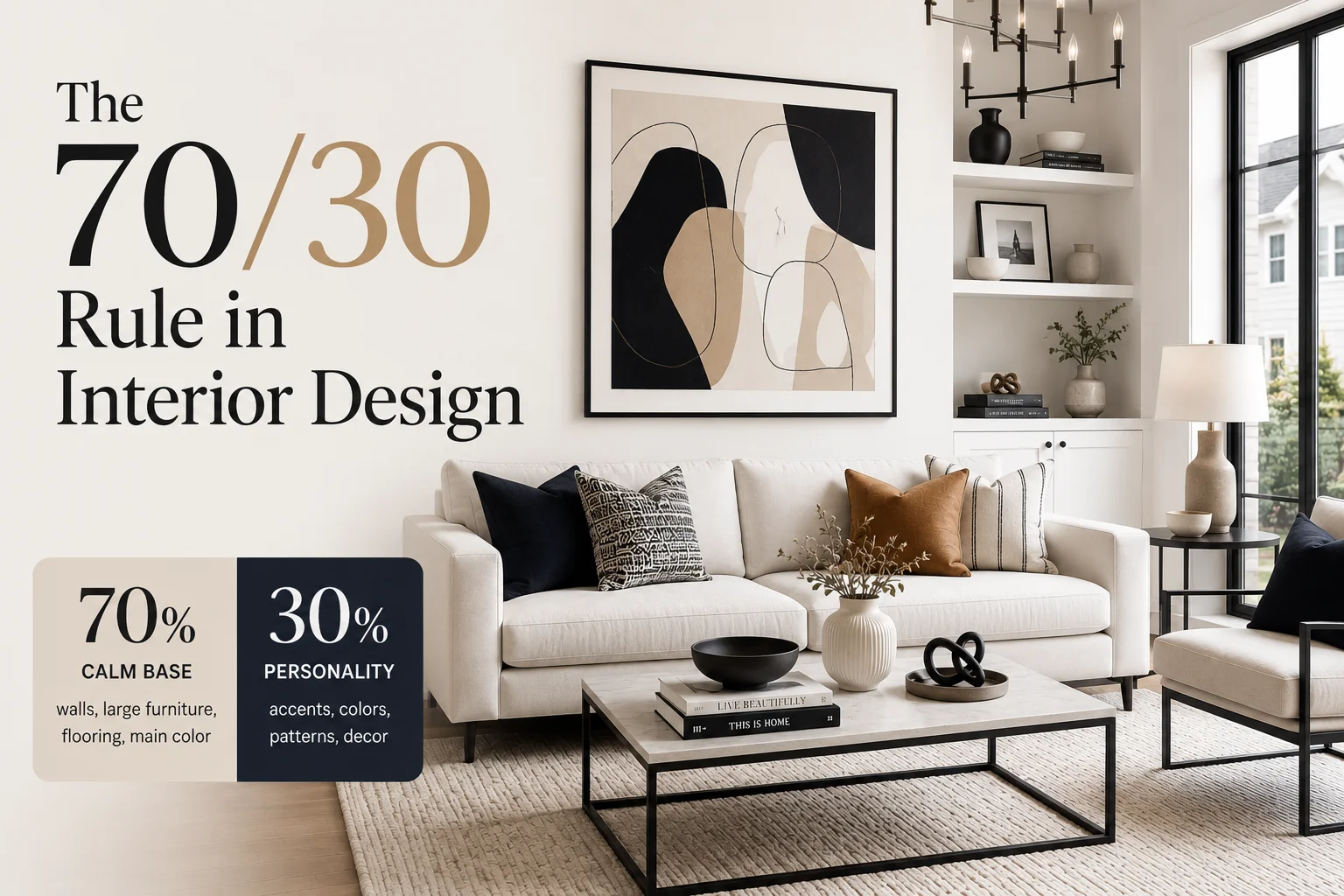
The idea is simple. About 70% of your room should be made up of one calm, steady base. This is your walls, your flooring, your big furniture, your main color. This is the foundation of the 70/30 Rule in Interior Design. The other 30% is where you get to have fun. This is your accent pieces, bold colors, patterns, and anything that adds personality.
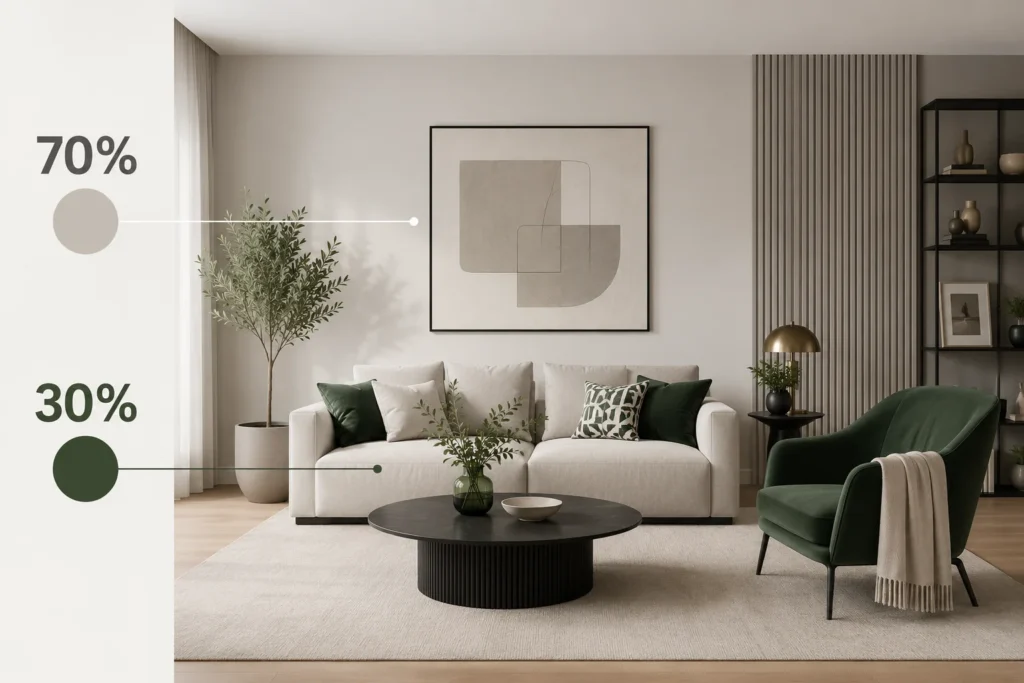
Think of the 70% as the quiet part of the room and the 30% as the part that makes people go “oh, I love that.”
A room decor that is 100% neutral tends to feel a little cold and forgettable. A room that is 50/50 loud colors and patterns everywhere usually feels stressful to sit in, even if you cannot explain why. The 70/30 split sits right in the sweet spot between the two.
Before I knew about this rule, I thought good home decorating meant everything had to match. Same wood tone, same color family, same style era, and the use of mirrors in the living room or dining room. That is actually the opposite of what makes a room interesting.
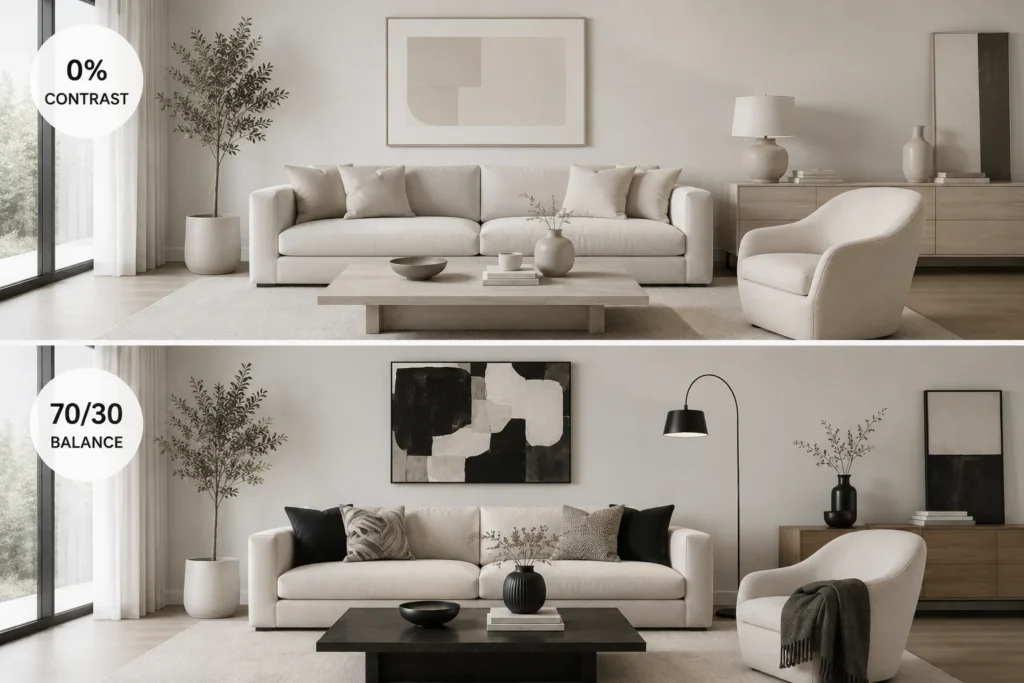
A room with zero contrast just blends together. Your eye has nowhere to land. The 70/30 rule in interior design works because it gives your base room something to rest on, while still leaving space for a few pieces that catch your eye. That contrast is what makes a room feel alive instead of like a furniture showroom.
Start your 70/30 rule in interior design, with the biggest, most permanent things in the room. Walls, flooring, ceiling, and your largest furniture piece, usually a sofa, bed, or dining table.
Pick a color or material family for these that you are genuinely happy looking at every single day, because you will be staring at it the most. Soft whites, warm beiges, muted greens, and soft greys are common choices for a reason. They are easy to live with and they let everything else in the room shine without competing.
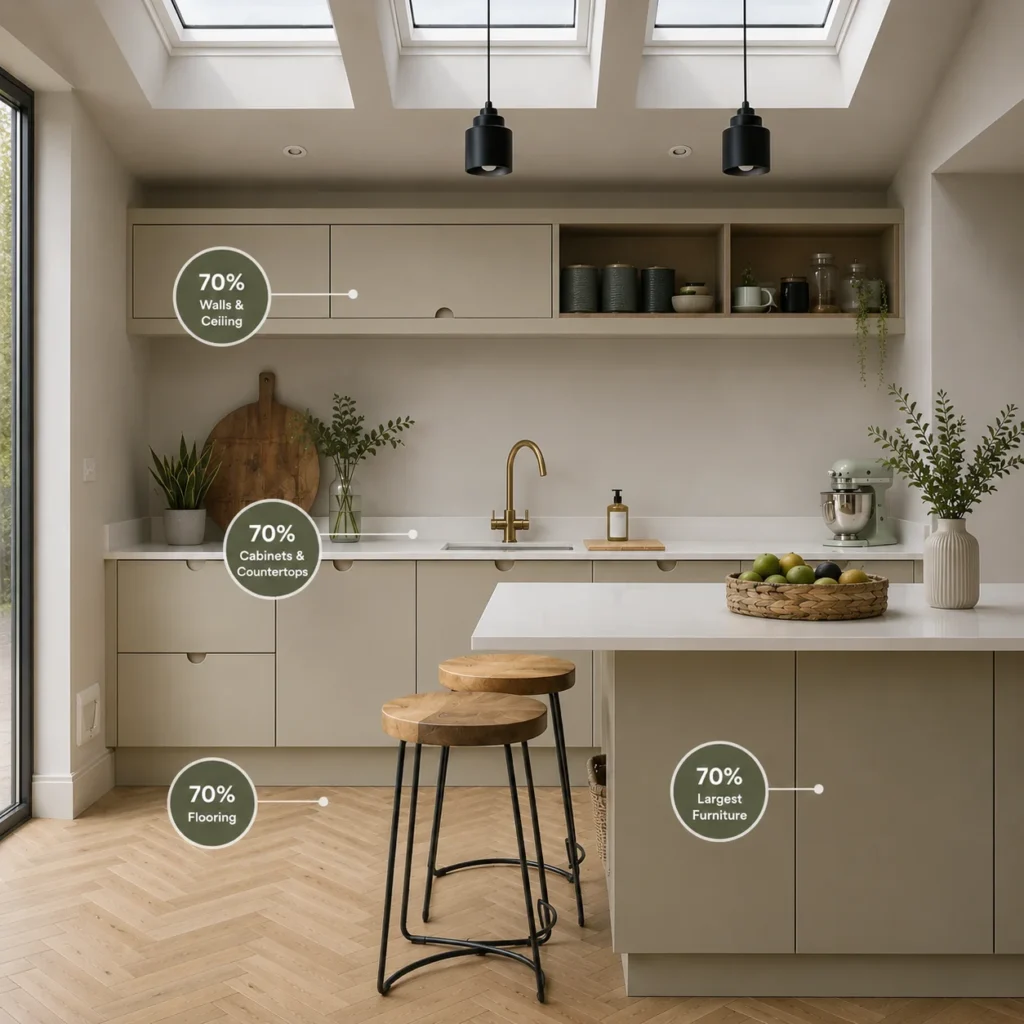
Your 70% does not have to be boring. It just needs to be steady. This is the part of the room you are not planning to change every year.
This is the part people usually get wrong when following the 70/30 Rule in Interior Design. They either go too safe and add almost no contrast, or they go too far and turn every accent piece into a statement, which cancels out the whole point.
Your 30% should include things that are easy to swap out later. Cushions, throws, art, a rug, a lamp, one accent chair, or a feature wall. These are the pieces carrying your personality, your favorite color, and any trend you are currently into.
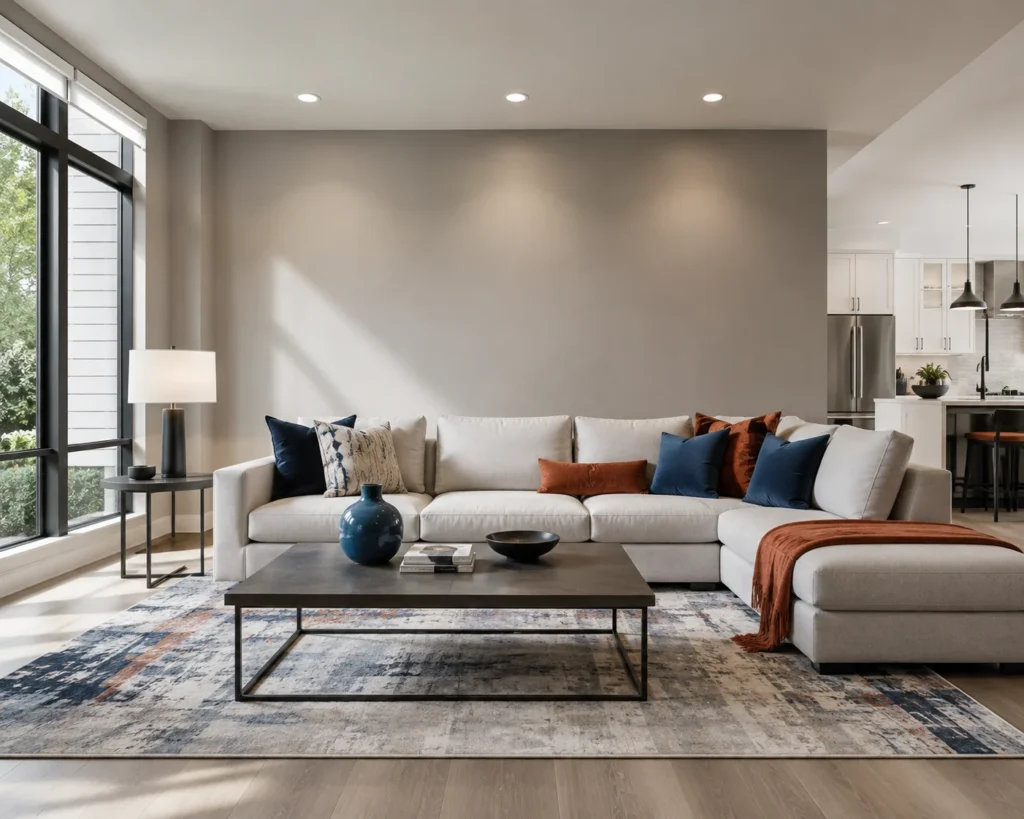
A good trick I use: pick one dominant accent color and let it show up two or three times around the room. Once on a cushion, once on a vase, once on artwork, for example. This makes the accent feel intentional instead of random and helps make the 70/30 Rule in Interior Design work naturally.
Color is usually the easiest place to start. Your 70% is your wall color plus your largest furniture pieces. Your 30% is anything that adds a pop, whether that is a bold cushion, a colorful rug, or a piece of art. The 70/30 Rule in Interior Design makes it easier to balance these colors without making the room feel overwhelming.
A living room with soft grey walls and a neutral sofa is your 70%. Add mustard cushions, a rust-colored throw, and one piece of bold wall art, and you have your 30%.. The neutral base keeps the room from feeling overwhelming, while the warm accents keep it from feeling flat.
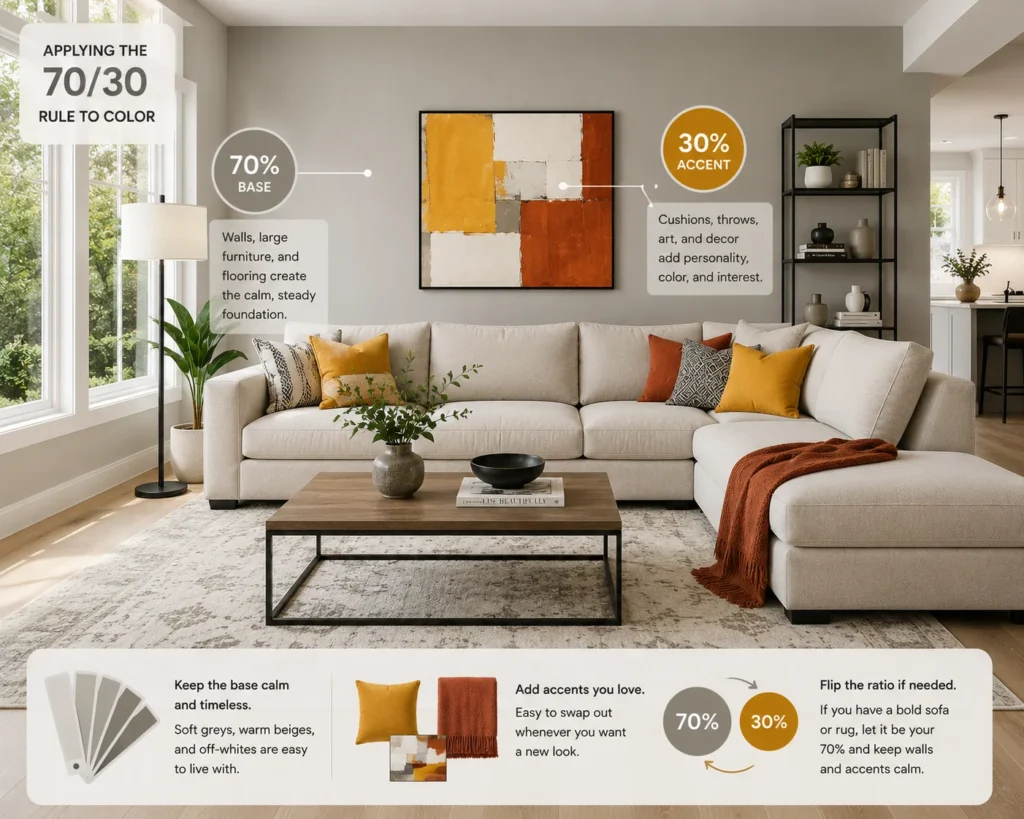
If you are nervous about color, this is the safest way to experiment. You are not repainting the whole room. You are just adding pieces you can change out in a weekend if you get tired of them.
I also think this is why so many people get stuck at the paint store for an hour holding swatches. They are trying to pick “the” color for the whole room, when really they only need to commit to one calm base color. Everything else is flexible and low commitment, which takes a lot of pressure off the decision.
If you already own a sofa or bed in a strong color and cannot change it right now, that is fine too. Just flip the ratio around it. Let that piece act as part of your 70% and choose a calmer wall color to balance it, rather than fighting to match everything perfectly. This is another practical way to apply the 70/30 Rule in Interior Design.
The same ratio works for texture. If every surface in your room has a different pattern, it starts to feel busy and hard to relax in. Keep your base textures simple, things like a plain linen sofa, a smooth painted wall, or a solid rug.
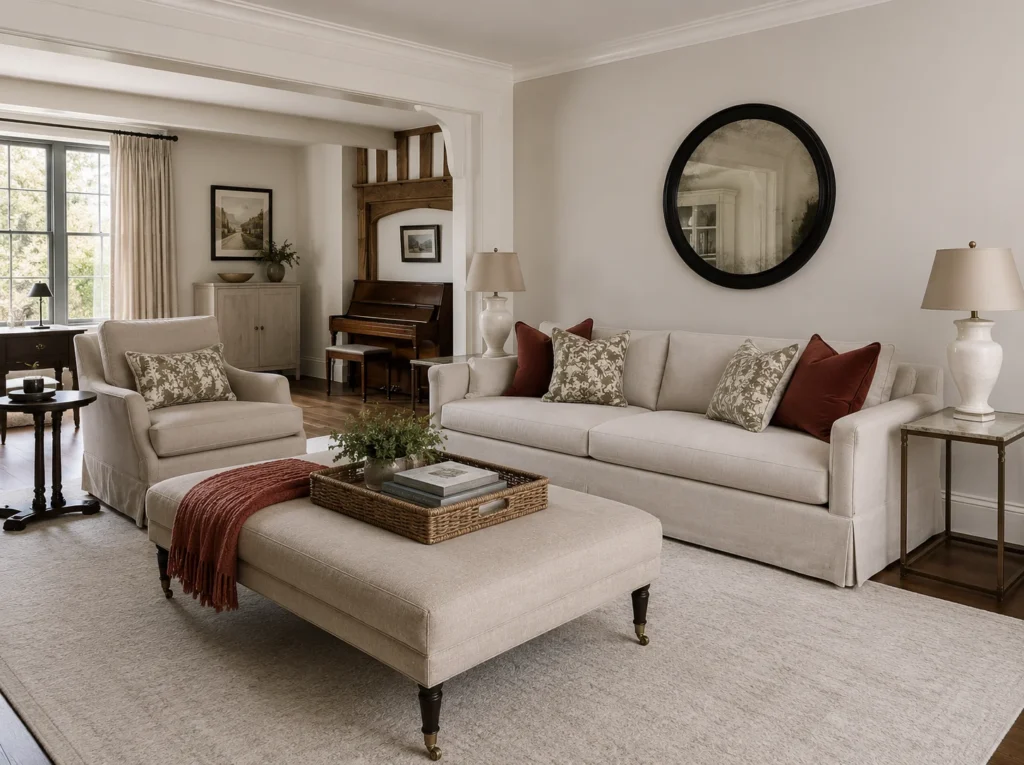
Then let your 30% carry the pattern. A patterned cushion, a textured throw, a woven basket, or one statement wallpaper wall. One or two patterned elements is usually enough to make a room feel layered without making it feel cluttered.
Your big furniture pieces, the sofa, bed, dining table, and main storage, make up your 70%. These should feel functional and comfortable first. Style comes second for these pieces because you use them every day.
Your 30% here can be a bold accent chair, an interesting side table, or a unique light fixture. These smaller pieces are where you can take a risk on a shape or color you would not want to commit to on a full sized sofa.
When arranging the room, let your eye land on the big pieces first, then notice the accents. If the accent pieces are competing with your main furniture for attention, the room will feel a little off, even if you cannot immediately say why.
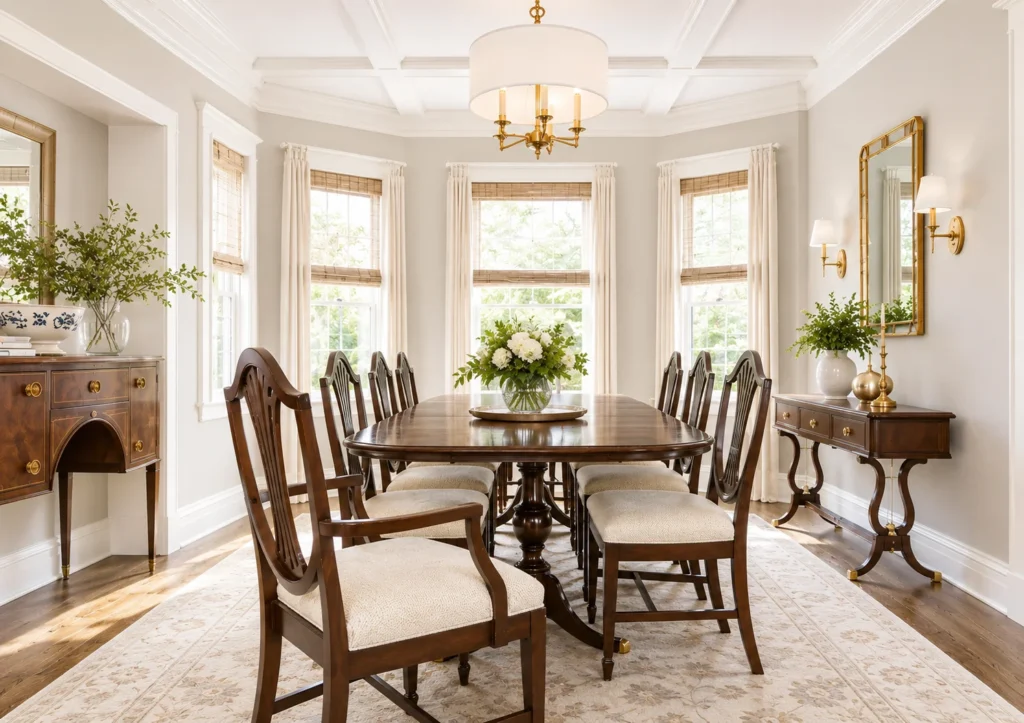
This is also a useful way to shop without overspending. Before buying anything new, ask yourself whether it is meant to be part of your base or part of your accents. Base pieces are worth spending more on since you will keep them for years. Accent pieces can usually be found secondhand, on sale, or thrifted, since you are more likely to swap them out down the line.
When I redid my living room, I kept the walls in a warm off white and got a plain oatmeal colored sofa. That was my 70%, boring on purpose.
For the 30%, I added a deep green velvet cushion, a rattan coffee table, and a big piece of art with warm orange tones. I also swapped my plain lamp for a ceramic one with a bit of texture.
None of these accent pieces were expensive. The whole point is that the neutral base did the heavy lifting, and a handful of cheaper accent pieces made the room feel finished. That was the first time a room of mine actually felt like it belonged in a magazine, even a slightly messy, lived-in one.
The biggest mistake is treating it as an exact measurement instead of a rough guide. Nobody is walking around your living room with a measuring tape checking percentages. It is meant to be a feeling, not a formula you calculate to the decimal.
Another common mistake is putting too much into the 30%. If you add five different accent colors, three patterns, and two statement pieces, you have gone past 30% without noticing, and the room starts to feel chaotic again.
The opposite mistake is being too scared to commit to any accents at all. A room that is 100% neutral with zero personality tends to feel unfinished, even if every piece in it is beautiful.
A smaller mistake, but one I made myself, is picking accent pieces that do not talk to each other at all. Your cushion, your art, and your rug do not need to match, but they should share at least one thing in common, whether that is a color, a warmth, or a general mood. Otherwise the 30% ends up feeling like a pile of random items instead of a chosen look.
You do not need to redo your whole home at once. Pick one room, usually the one that bothers you the most, and start there. Look at what is already your 70% and decide if it needs to change, or if you just need to add a stronger 30%.
Once you get comfortable with the ratio in one room, it becomes second nature. You start seeing every purchase as either a base piece or an accent piece, which makes shopping for your home a lot less overwhelming and a lot less impulsive.
The 70/30 rule will not fix every decorating problem, and it is not the only rule worth knowing. But if you want one simple habit that instantly makes a room feel more put together, this is the one I would tell a friend to try first.
For more home decorating ideas, check The Decor Dash
It actually works better in small rooms. A small space gets visually crowded fast, so keeping 70% of it calm and consistent stops it from feeling cramped, while your 30% accents still give it personality.
Yes, but keep it to two colors at most that work well together, rather than scattering five random ones around. Too many accent colors is usually what makes the 30% feel messy instead of intentional.
You do not need to get rid of anything. Group your existing pieces into “base” and “accent” mentally, lean into whichever color shows up most as your 70%, and let the rest play the role of your 30% accents.
They are cousins, not twins. The 60/30/10 rule splits colors into three tiers (main, secondary, accent), while the 70/30 rule is a simpler two-part split that covers color, pattern, and furniture all at once, which is why I find it easier to actually remember while shopping.
Stand in the doorway and look at the room for a few seconds. If your eyes do not know where to land, you probably need less clutter in your 30%. If the room feels flat or forgettable, you probably need a bit more.